
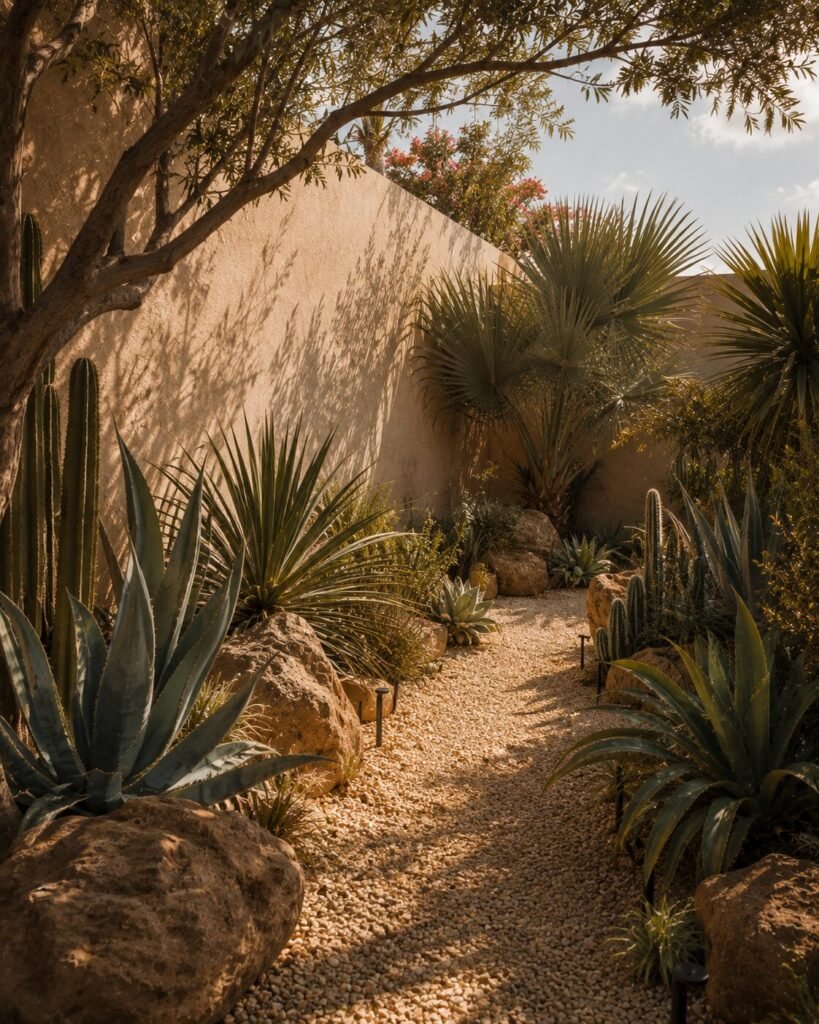
Let’s be honest about something the gardening world rarely admits: most of us don’t want to garden. We want to have gardened. We want the green, the shade, the birds, the courtyard-jungle feeling — without surrendering every Saturday to it.
Good news: that garden exists. And the first thing to get straight is that lush has almost nothing to do with water.
Lush is a density effect. It is the feeling of plants touching each other, of layers, of not being able to see the ground. A courtyard packed with agaves, grasses and palms reads as more lush than a lawn with six shrubs spaced politely apart — and it does it on rainfall alone. What people mistake for tropical abundance is usually just plants planted close together.
Which is convenient, because the plants that survive dry heat and constant wind without help are exactly the sculptural ones that look best en masse.
The secret is selection, not effort
A high-maintenance garden is usually just the wrong plants in the wrong place, kept alive by heroic intervention. A low-maintenance garden flips it: plants chosen for your actual sun, soil and rainfall, which then largely run themselves.
Where the trade winds blow steadily, this matters more than it does anywhere else. Wind dries soil faster than heat does. A plant that would be merely thirsty in a sheltered garden is in real trouble in an exposed one, and no amount of watering fixes a species that was never going to make it. Choose for the wind and you stop fighting.
The lazy-lush formula has three layers.
The backbone — structural plants. Big, sculptural, nearly indestructible: agaves, yuccas, dracaenas, fan palms, ornamental grasses. They give the garden its shape and look intentional even when everything else is having a bad month. Plant them closer than the label says. The label is written for a nursery, not for a courtyard you want to feel full.
The fill — tough spreaders. Low, dense planting that crowds out weeds so you don’t have to fight them: trailing rosemary, lantana, purslane, dwarf carissa, aloes tucked between rocks. Dense planting is the laziest weed control ever invented, and in gravel it does the job better than mulch alone.
The moment — one hero. Every effortless-looking garden has a single deliberate showpiece: a frangipani, a bougainvillea over a doorway, one mature agave given room to be looked at. One. Not seven. The restraint is what makes the rest read as designed rather than accumulated.
Water once, the smart way
The only real work in a lazy garden happens on day one: soak new plants deeply and mulch generously.
Gravel is the mulch that makes sense here. Bark blows away in steady wind and breaks down fast in heat. Gravel or crushed shell holds moisture in the soil beneath, blocks weeds, reflects light, and reads as a finished surface rather than a temporary one. It is also the reason a dry garden looks composed instead of sparse — the ground itself becomes part of the design.
After establishment, drought-adapted planting mostly ignores you. That is the whole trick: eighteen months of patience buys a decade of neglect.
If even hand-watering offends your schedule, a simple drip kit on a tap timer turns the establishment period automatic. Set it once, run it for a season, then turn it off and let the garden stand on its own.
The lazy garden shopping list
- Gravel or crushed shell, and lots of it. Enough to cover every bit of visible soil.
- Big pots. Small pots dry out in a single windy afternoon and demand daily attention; large planters forgive you for a week. Terracotta, always terracotta — unglazed clay breathes, and it belongs in this light.
- One good pair of pruners. Ten minutes of snipping a month is the entire maintenance programme.
- A few large rocks. Unfashionable to say, but they anchor a gravel garden and cost nothing but delivery.
Permission granted
A garden is not a test of character. If the plants are thriving and you’re in the hammock, you haven’t cheated — you’ve designed well.
Our editorial director has held this position for roughly forty million years, and has never watered anything.
In one line
Lush is about how close the plants stand, not how much you water them.
Garden Design Co. — Ideas, spaces and objects that elevate outdoor living.