
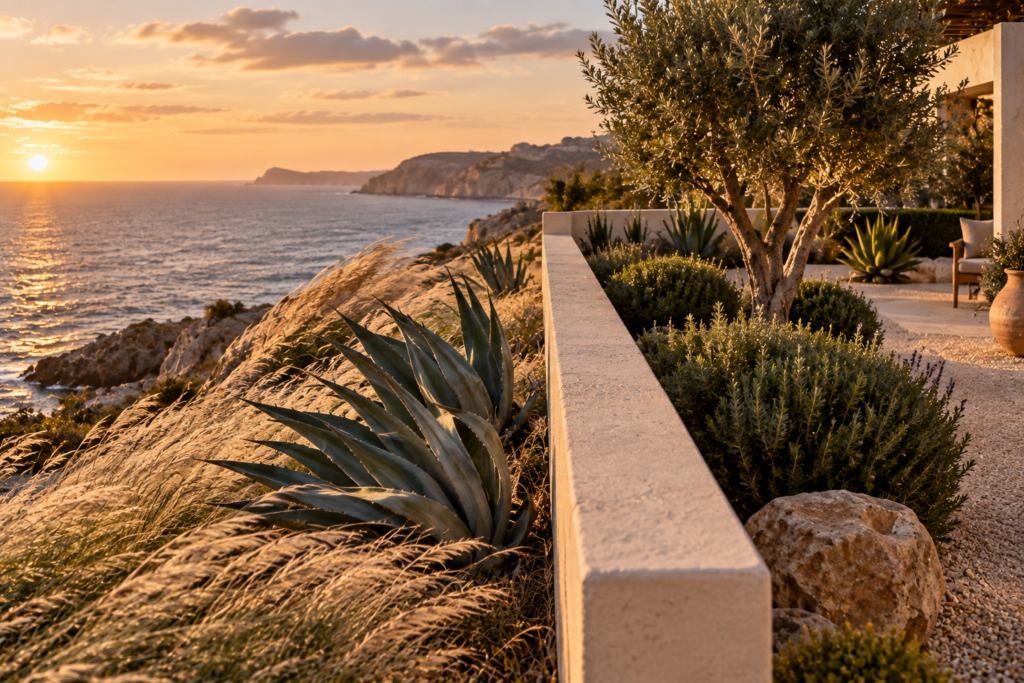
Every outdoor question has the same unhelpful answer: it depends.
Which decking? It depends. Which stainless? It depends. Which plants, which fabric, which light fitting, which gate? It depends.
What it depends on is almost always the same single variable, and almost nobody names it. How exposed are you? Not which country you live in, not your hardiness zone, not the average temperature. How much salt, wind and reflected light actually reaches the thing you are about to buy.
Short answer, up front. There are three exposure zones. The same product can be essential in one, sensible in the next and a waste of money in the third. Work out which zone you are in and most outdoor decisions stop being guesswork.
Why distance matters more than climate
Two gardens four hundred metres apart can need entirely different specifications. One loses its gate hardware in eighteen months; the other keeps the same fittings for a decade. Same island, same rainfall, same sun.
Salt does not travel evenly. It rides on wind, drops out of the air as that wind slows, and gets stopped by walls, buildings, planting and rising ground. A single row of houses between you and open water can cut salt deposition dramatically. So can a dense hedge.
This is why national advice fails. A guide written for coastal Spain, coastal Queensland, the Gulf Coast or the Caribbean is describing a climate. Your problem is a microclimate, and it is measured in metres.
The three zones
Forget precise distances. Distance is a poor proxy because a cliff, a treeline or a row of buildings changes everything. Use what you can observe instead.
Zone 1 — Front line
You are in Zone 1 if: you can taste salt on the air on a windy day. Your windows film up between cleans. Untreated steel shows rust within a season. Plants on the seaward side grow visibly leaning, or brown off on one flank. Nothing stands between you and open water but sand, rock or low scrub.
Here the wind is not weather, it is a permanent structural load, and salt is a chemical attack running twenty-four hours a day. Almost every product sold as suitable for outdoor use will fail here, because almost every product is specified for Zone 3.
Zone 2 — Moderate exposure
You are in Zone 2 if: you get salt-laden wind but rarely direct spray. There are buildings, walls or mature planting between you and the water. Metal corrodes faster than friends inland complain about, but not catastrophically. Some corners of the garden are noticeably calmer than others.
This is where most coastal properties actually sit, and where most money gets wasted in both directions — people either over-specify for a front-line condition they do not have, or use inland products and replace them twice as often as they should.
Zone 3 — Sheltered coastal
You are in Zone 3 if: you have a maritime climate, occasional strong wind, and essentially no salt deposit. Ordinary outdoor products last roughly as long as the manufacturer claims.
Zone 3 is where mainstream outdoor living advice is written, and if you are here you can largely follow it. Most people reading this are not here.
What actually changes by zone
Metals and fixings
The clearest example, and the one that costs people most. Cheap outdoor products described as stainless are usually 430 grade, which will show rust within a year of salt air anywhere in Zone 1 or 2. 304 is the sensible minimum for Zone 2. 316 is marine grade and the only honest choice for Zone 1.
The frustrating part is that the fixings usually fail long before the thing they are holding. A hardwood gate outlives its hinges. A pergola outlives its brackets. Specify the metal for your zone and the structure lasts as long as it should — a point that runs through Gates: Aluminum vs Wood vs Synthetic.
Shade and structures
In Zone 1 a tensioned fabric sail is a permanent lever working against its anchors. In Zone 3 it is a parasol that happens to be attached to a wall. Same product, completely different engineering problem — which is the whole argument in Shade Sails vs Pergolas.
Zone 1 wants fixed structure and porous screening. Zone 2 can run either. Zone 3 can use whatever looks best.
Wind management
Zone 1 and 2 both need the counterintuitive rule that solid walls make wind worse rather than better — covered in Wind Is Why You Don’t Use Your Patio and solved elegantly by breeze blocks. Zone 3 rarely needs to think about it at all.
Surfaces underfoot
Reflected light and heat rise sharply as shelter falls away. In Zone 1 a dark sealed surface becomes unusable barefoot by mid-morning, which is part of why unglazed terracotta keeps returning — porous clay simply holds less heat than a sealed one.
Planting
Zone 1 needs true halophytes: plants that survive salt in the soil and on the leaf. Zone 2 can use drought-tolerant planting with a windbreak layer on the seaward side. Zone 3 can plant almost anything that suits the rainfall.
Density does more work than any single species choice, which is the argument in The Lazy Person’s Lush Garden — plants shelter each other, and a thick planting survives conditions that would kill the same plants spaced out.
How to place yourself in ten minutes
Go outside on a windy afternoon and check four things.
Taste. Salt on your lips means Zone 1.
Glass. How quickly windows film up between cleans.
Metal. Find the oldest untreated steel on the property — a bolt, a bracket, a railing — and look at it honestly.
Plants. Do they lean? Is one side browner than the other? Plants report wind and salt more accurately than any measurement you can take yourself.
Then look at what is between you and the water. Not how far — what. One row of buildings is worth several hundred metres of open ground.
Why this is worth doing once, properly
Because it converts every future decision from a guess into a lookup. You stop asking whether a product is good and start asking whether it is good for your zone, which is a question with an answer.
It also saves real money in both directions. Zone 1 properties routinely buy Zone 3 products and replace them annually. Zone 3 properties routinely buy marine-grade everything and pay three times over for corrosion resistance they will never need.
FAQ
How far inland does salt air actually reach?
There is no single distance. Salt travels on wind and drops as wind slows, so obstruction matters more than distance. A sheltered garden 200m from water can be less exposed than an open one at 800m.
What grade of stainless steel do I need near the sea?
316 marine grade for front-line exposure, 304 as a minimum for moderate exposure. Avoid 430, which is what most budget outdoor products use.
Does this apply outside the tropics?
Yes. The zones describe exposure, not climate. A front-line garden in Cornwall, Galicia, coastal Queensland or Cape Town faces the same salt and wind mechanics as one in the Caribbean. The plant lists differ; the engineering does not.
Our iguana’s position
He has occupied the same sheltered corner for years and has never once been asked to justify the choice. He was in Zone 3 before it had a name.
In one line
Work out how exposed you are before you buy anything, because the right answer in one zone is an expensive mistake in another.
Garden Design Co. — Ideas, spaces and objects that elevate outdoor living.