
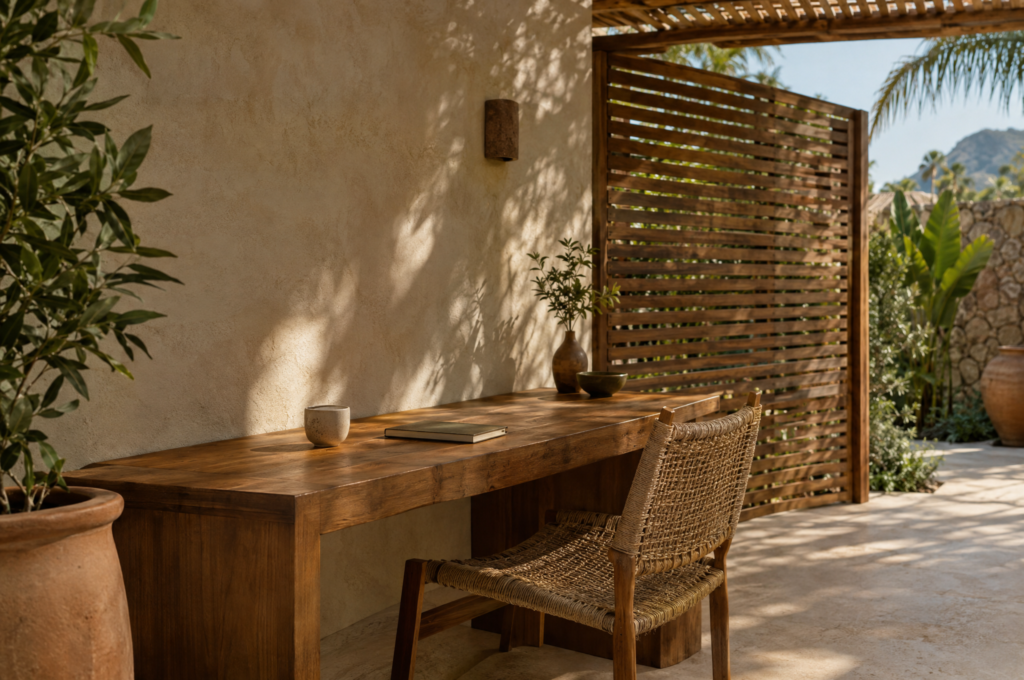
Working outdoors sounds wonderful right up until the trade wind lifts an invoice off the table and lodges it in the neighbour’s frangipani. Almost everyone in Aruba, Curaçao or Bonaire has tried the outdoor-office fantasy at least once — laptop on the patio table, coffee within reach, ocean somewhere in the frame — and most have given up by the second video call, when the wind noise on the microphone made them sound like they were dialing in from inside a jet engine. Which, in a sense, they were.
So does an outdoor workspace actually hold up here, or is it a look borrowed from a climate that never has to fight for it? The honest answer: yes, it works — but only if you design against the wind and the glare from the start, not after the third ruined afternoon. The ABC islands run a near-constant 15 to 20 knot trade wind and a high, flat sun angle for most of the year. Those two facts decide whether a desk outside is a pleasure or a standing joke. Get them right and the rest — power, furniture, Wi-Fi — falls into place easily enough.
The wind decides before you do
We’ve written before about why wind is the real reason people abandon their patios, and a desk is just a dinner table with worse manners about it. Loose paper, a laptop that won’t stay angled, a coffee that goes lukewarm because the cup won’t hold heat in moving air — none of that is a defect in your setup. It is what an unbroken 15-knot wind does to anything not weighted or walled.
The fix isn’t a bigger umbrella. It’s a windbreak with intention: a low wall, dense planting, or the house itself positioned so your back — not your face — takes the wind. Orientation matters more than equipment here. A desk angled thirty degrees off the prevailing wind loses most of the chaos without losing the breeze that makes sitting outside worth it in the first place.
Shade is the real infrastructure
A screen in direct island sun is close to unreadable by ten in the morning, and squinting at a laptop for six hours is a fast way to end the outdoor-office experiment for good. This is where the structure above your head matters as much as the desk below it. We compared shade sails against pergolas for constant coastal wind, and the short version applies directly to a workspace: sails move too much in gusty wind for a stable work surface underneath, while a well-anchored pergola earns its keep by staying put and giving you fixed, predictable shade at the same hours every day — which matters when your 10am call is always at 10am.
Slatted roofing over solid is worth the trade here too. Full shade blocks glare but also blocks the breeze that keeps you outside instead of retreating to air conditioning by eleven. A pergola with adjustable louvres or a simple slatted timber roof splits the difference.
What the brochure photo leaves out
Nobody markets the parts that make an outdoor workspace genuinely usable, and they’re mostly unglamorous. Salt air is unkind to laptop hinges and keyboard switches over a year of daily use — wipe down at the end of each session, more if you’re near open water. Wi-Fi signal drops fast past exterior walls, so budget for a mesh extender rather than hoping the router in the living room reaches the patio. Sudden squalls are common enough in the wetter months (more of a St. Maarten and Saba concern than an ABC-islands one) that anything you can’t grab and run with in under ten seconds shouldn’t be out there unprotected. And a proper outdoor power point, weatherproofed and on its own circuit, costs more upfront than an extension cord threaded under a door — but it’s the difference between a workspace and a weekend improvisation.
None of this is a reason not to do it. It’s a reason to budget the shade structure and the windbreak before the standing desk and the good chair, because the furniture doesn’t matter if the wind and the glare win first.
The iguana who suns himself against our east wall has technically been “working outside” longer than any of us. His review of the whole exercise is a slow blink and an unbothered return to his rock. He has never lost a printout to the wind. He has also never taken a video call, which may be the actual secret.
In one line
An outdoor workspace works in the ABC islands only when it’s built to survive the wind and the glare — not just photographed before either one shows up.
FAQ
Can you really work outside all day in Aruba or Curaçao?
For parts of the day, yes — early morning and late afternoon are the most comfortable. Midday sun and peak wind make a well-shaded, wind-broken setup necessary rather than optional.
Is a pergola or a shade sail better for an outdoor desk?
A pergola generally suits a fixed workspace better because it stays stable in constant wind and gives shade at consistent hours; a shade sail moves more and suits looser, occasional-use spaces.
What actually ruins outdoor laptops in this climate?
Salt air corrosion on hinges and ports, dust and sand in keyboards, and sudden humidity swings during squalls — regular wipe-downs and a case that closes fast make the biggest difference.
Garden Design Co. — Ideas, spaces and objects that elevate outdoor living.