
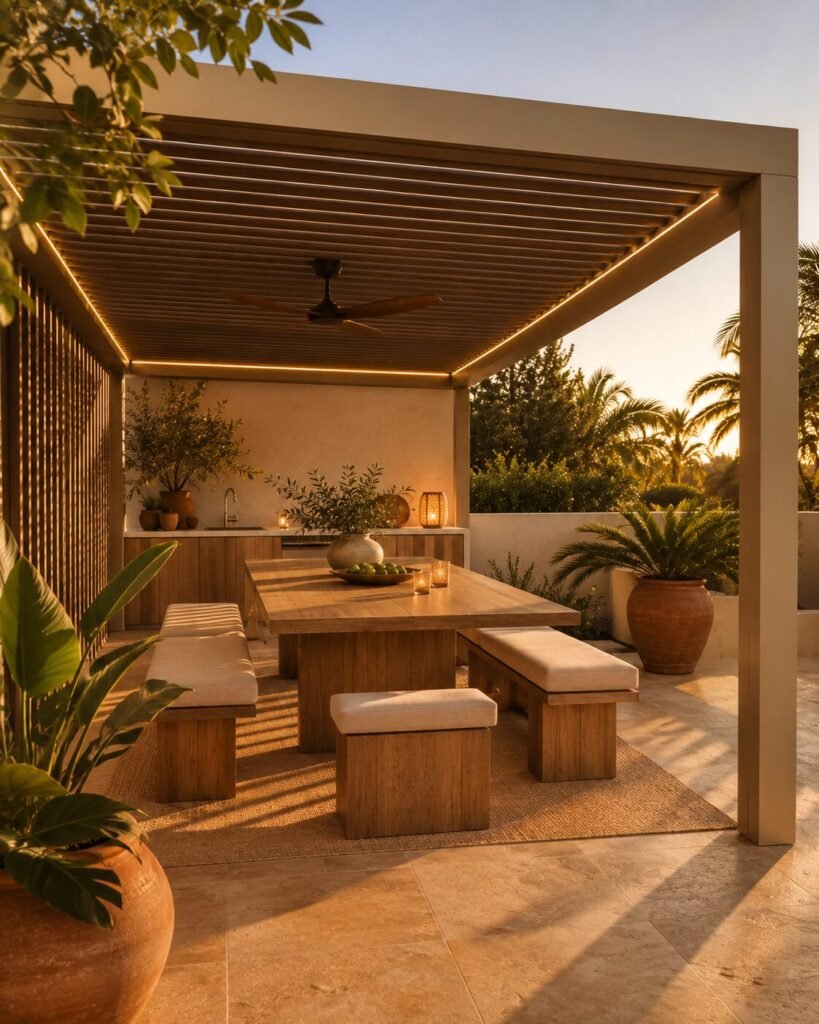
Here is the strange thing about an empty yard: it can be beautifully planted, well paved, generously sized — and still feel like nowhere.
People walk out, stand for a moment, and go back inside. Not because anything is wrong. Because there is nothing telling them where to be.
That is the job a pergola does, and it is why it has quietly become the most important structure in outdoor design. In 2026, pergolas, pavilions and gazebos stopped being shade accessories and became the anchor that organises the entire space — the thing that gives a yard a centre of gravity.
What a pergola actually does
Shade is the obvious answer and the least interesting one.
A pergola creates a room without walls. It draws a ceiling line over a patch of ground, and the moment there is a ceiling, the space underneath becomes a place. Put a table there and it is a dining room. Put two loungers there and it is a living room. The furniture was always possible; the pergola is what made it feel intentional.
It also does three quieter things:
It adds height. Most yards are flat and low. A structure that rises gives the eye somewhere to travel and makes the whole space read as designed rather than leftover.
It creates a destination. A yard with a pergola has a there to walk to. That sounds small. It changes how often the space gets used.
It buys you hours. The difference between a patio usable from six in the evening and one usable from two in the afternoon is a roof. In a hot climate, that is not comfort — that is the whole point.
Materials: the honest comparison
Timber is the classic and still the most beautiful. It weathers into something better than it started. It also asks for maintenance — sealing, occasional replacement of a beam, vigilance about termites and rot in humid climates. Hardwoods handle this far better than softwoods, and cost accordingly. Choose timber if you want warmth and are prepared to look after it.
Aluminium has stopped being the ugly option. Modern powder-coated aluminium pergolas are clean-lined, essentially maintenance-free, and impervious to rot, insects and salt air. In coastal and tropical settings this matters enormously. They cost more up front and less forever. Choose aluminium if you live near the sea or simply do not want a maintenance relationship with your yard.
Steel is the strongest and the rarest in residential use — excellent for wide spans, but heavy, expensive, and requiring proper rust protection.
Composite and vinyl sit in between: low maintenance, moderate cost, and honestly, a slightly plastic feel up close. Fine at a distance, less lovely at the table.
Fixed roof, louvred, or open?
Open slats are the traditional pergola: light and shadow, a climbing plant overhead, dappled sun. Beautiful, atmospheric, and no help at all in rain.
Louvred (adjustable) roofs are the significant upgrade of the last few years. Angled blades you can open for light or close for shelter, some motorised. They turn a fair-weather structure into a year-round one. They are also considerably more expensive.
Solid roofs give complete shelter and effectively create an outdoor room, but they cast heavy shade and can make the adjacent indoor rooms darker than you expect. Check what the pergola does to your interior light before committing.
For most people in warm climates, open slats plus a climbing plant delivers 80% of the benefit for 30% of the cost. Bougainvillea over timber is not a compromise — it is the goal.
Getting the size right
The most common mistake is building too small.
A pergola that covers a table but not the chairs pulled out from it is a pergola that fails at dinner. Measure the furniture, then add at least 90cm on every side for chairs and movement. For a six-person dining setup, that usually means a minimum of about 3.5 × 4 metres.
Height matters too. Under about 2.4 metres, a pergola feels oppressive; around 2.7 metres feels generous without losing intimacy.
And place it where the sun actually is at the hour you will use it. Not where the yard looks emptiest. Stand outside at 4pm with a coffee and mark the spot you naturally want to sit. That is where it goes.
What it costs, honestly
A basic timber kit is the entry point. A large custom hardwood structure with a louvred roof, built by professionals, can cost as much as a small car.
The gap between those numbers is enormous — and it is also where the outdoor-living market hides its worst markups. A pergola quoted locally at three times the landed cost of the same materials is not unusual. Before you accept a quote, price the components. Ask what the structure actually consists of. You may find that importing a kit and paying a local builder to erect it costs half of a turnkey quote.
If a pergola is not in the budget yet
A shade sail costs a fraction and delivers real usable shade. It will not organise the space the way a structure does, but it buys you afternoons — and afternoons are what you are actually purchasing.
Our iguana, for the record, has strong opinions about shade. He considers the pergola the single greatest invention in outdoor living, narrowly ahead of the cold drink.
In one line
A pergola is not a decoration you add to a finished yard. It is the decision that makes the rest of the yard make sense.
Garden Design Co. — Ideas, spaces and objects that elevate outdoor living.