
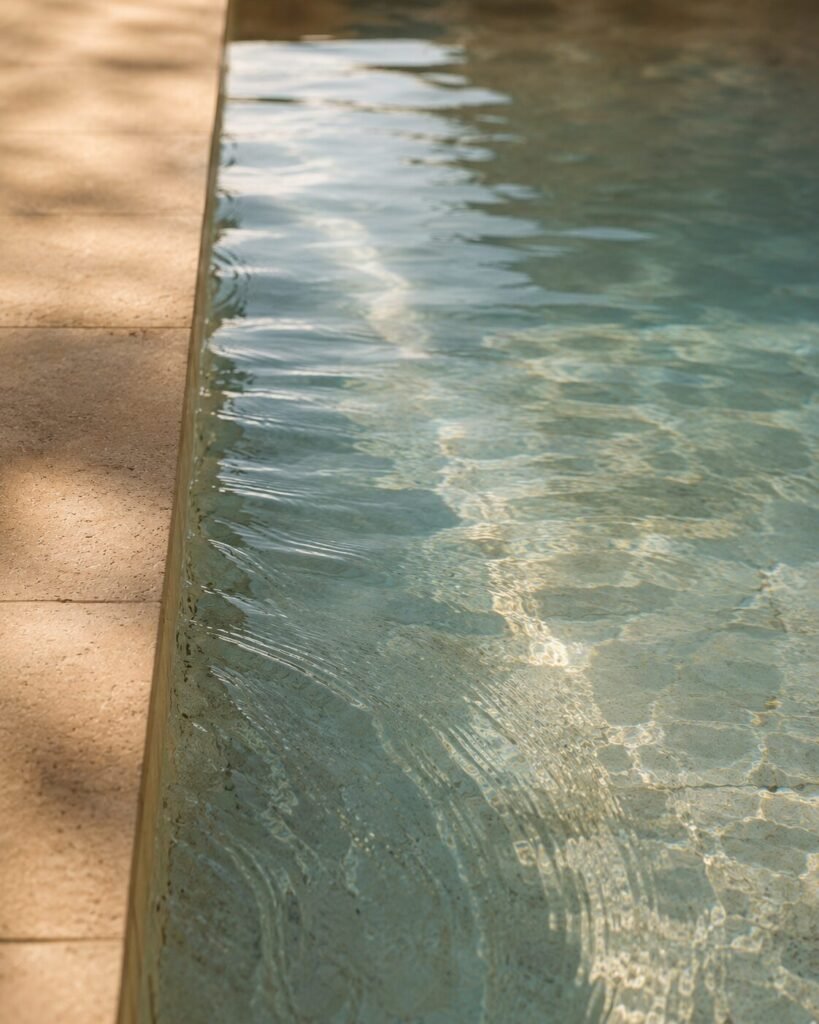
There are two kinds of pool owners.
The first checks the water occasionally, notices it looking cloudy, panics, dumps in chemicals, waits, panics again, and eventually calls someone. This cycle repeats roughly monthly and costs a small fortune in shock treatment and regret.
The second spends about ten minutes a week and almost never thinks about it.
The difference between them is not knowledge of chemistry. It is a handful of boring habits.
Algae is a maintenance problem wearing a chemistry costume
When water goes green, the instinct is to treat the water. But algae rarely appears because the chemistry was wrong last Tuesday. It appears because something has been slightly off for weeks and nobody noticed.
Three things allow algae in, almost always in this order:
Circulation stopped being adequate. Water that does not move is water that grows things. Pumps get run for fewer hours to save electricity, and the saving is real — right up until the day it costs you a full shock treatment and three days of cloudy water.
Filtration got lazy. A filter that has not been cleaned is doing a fraction of its job while appearing to work perfectly. There is no warning light. It just quietly stops filtering.
Sanitiser dropped and stayed down. Chlorine burns off in sun and heat far faster than most people expect. A pool that tested fine on Sunday can be unprotected by Wednesday in strong sun.
Fix those three and algae mostly stops being a thing that happens to you.
The ten-minute week
Brush the walls and steps. This is the single most skipped and most valuable task. Algae begins as a film on surfaces long before it colours the water. Brushing removes it while it is still nothing. Corners, steps and behind the ladder are where it starts — the places water moves least.
Empty the skimmer and pump baskets. Leaves in the basket restrict flow, which reduces circulation, which brings us back to problem number one.
Test the water. Not a full laboratory panel — sanitiser and pH. Two numbers. Test strips take fifteen seconds.
Look at the water for ten seconds. Genuinely. Clarity changes before colour does. If it looks slightly less sharp than usual, act now, while acting is cheap.
The two numbers that matter most
pH controls whether your sanitiser works at all. Chlorine at high pH is dramatically less effective — you can have plenty of chlorine in the water and still get algae, because the chemistry has made it lazy. Keeping pH in range is what makes everything else work.
Sanitiser level needs to be consistent, not occasionally high. A pool that swings between heavily dosed and unprotected is far more algae-prone than one held steadily in range. Consistency beats intensity — which, coincidentally, is true of almost everything.
Run the pump longer than feels necessary
The most common cost-saving mistake is cutting pump hours. In warm climates, water should turn over completely each day, and that usually takes longer than people run it.
If electricity cost is the concern, the modern answer is a variable-speed pump running longer at lower speed. It moves the same water for meaningfully less power. It costs more to buy and pays for itself in a way that is genuinely measurable.
Cover the water
A pool cover is the least glamorous purchase in outdoor living and one of the most effective. It reduces evaporation, keeps out debris, holds heat, and — importantly for algae — blocks the sunlight that both fuels growth and destroys your chlorine.
Covers are not beautiful. Neither is a green pool.
The small pool advantage
If you have read our case for compact pools, here is another entry for the ledger: a small pool is dramatically easier to keep clean. Less water to circulate, less surface to brush, less chemical to balance, faster to recover when something goes wrong.
The pool you can maintain in ten minutes is the pool that stays swimmable. The one that takes an hour becomes the one you avoid.
When to call someone
Persistent cloudiness after correcting chemistry, staining you cannot brush off, equipment noises that are new, or a leak you suspect but cannot find — these are worth a professional. Everything above is worth doing yourself.
And when you do call someone, the same rules apply as with any contractor: a real address, a job you can go and look at, and an itemised quote.
Our iguana’s philosophy on pool care is that the water should require less attention than the drink you are holding beside it. Ten minutes a week is what buys that.
In one line
Brush the walls, clean the baskets, run the pump longer, and keep pH honest. Algae is not a chemistry emergency — it is the bill for a month of small neglects.