
Everyone can spot bad artificial grass instantly.
It is uniformly bright. It has a faint plastic sheen in sunlight. It sits flat like carpet. And it announces itself from across the street.
Good artificial grass is genuinely hard to identify at a glance — and the difference between the two is not price alone. It is three specifications almost nobody asks about.
Why it deserves consideration
Let’s address the snobbery first. Artificial grass has a reputation problem among people who love gardens, and some of it is deserved. It is not living. It supports no insects. It is a plastic product.
But in a dry climate, a real lawn is one of the thirstiest things you can own — a permanent, expensive irrigation commitment for a surface that still browns in the worst weeks. In a small courtyard with heavy shade, grass simply refuses to establish at all. And for households with dogs or children who actually use the space daily, a real lawn becomes a mud management project.
The honest position is not that artificial grass is better. It is that in specific situations — drought, deep shade, heavy use, tiny spaces — it solves a problem real grass cannot.
Use it where it earns its place. Not wall to wall.
The three specifications that actually matter
1. Pile height
This is the length of the blades, and it is where most people go wrong by going long.
Very short piles look like sports turf. Very long piles look luxurious in the showroom and then flatten within months into a matted, obviously fake surface — because long blades lack the stiffness to stand back up under foot traffic.
The convincing range for domestic use is the middle: long enough to look soft, short enough to recover. If you want one rule: when in doubt, go shorter than the sample that impressed you.
2. Colour mix
Real grass is never one colour. It contains yellow-greens, blue-greens, olive tones, and — critically — brown.
The single fastest way to identify cheap turf is uniform bright green. Quality products blend multiple green tones and include a brown thatch layer at the base, imitating the dead material that sits under any real lawn. That thatch layer does more for realism than any other feature.
If a sample is one flat green, it will look fake forever, regardless of price.
3. Density and backing
Density is how many stitches per unit area. Higher density means blades support each other, stand up longer, and resist matting. It also means more material, which is why density tracks closely with price.
The backing matters for drainage — it must be properly perforated, especially with pets or heavy rain. Poor drainage is what causes the smell that artificial grass is unfairly famous for. Well-drained turf on a proper base does not smell.
The base is the whole job
Here is what installers know and buyers do not: the grass is maybe a third of the outcome. The base is the rest.
A proper installation means excavation, a compacted aggregate base, a levelling layer, weed membrane, and correct edge fixing. Skip any of it and you get dips, drainage failures, weeds pushing through joins, and edges that lift.
Artificial grass laid straight onto soil will look acceptable for one season and terrible for every season after.
This is precisely where the contractor question matters. Ask specifically what base build-up is included in the quote and how deep the excavation goes. A quote that does not mention the base is a quote for a temporary result.
Heat: the thing nobody mentions in the brochure
Artificial grass gets hot. In strong direct sun it can become genuinely uncomfortable to walk on barefoot and unpleasant for dogs at midday.
Some products now use heat-reflective technology, and they help — but physics is physics. Plan for it: use artificial grass in areas with some afternoon shade, or accept that midday is not lawn time. A pergola or a tree nearby changes this dramatically.
Maintenance is not zero
It is low, not none. Brush it periodically against the grain to keep blades upright, rinse it occasionally, remove leaves before they break down into the pile and feed weeds, and treat the perimeter where weeds actually arrive.
Ten minutes a month, roughly. Compared with mowing, watering and feeding, that is still a rout.
The design move that makes it convincing
Do not lay it edge to edge like a carpet.
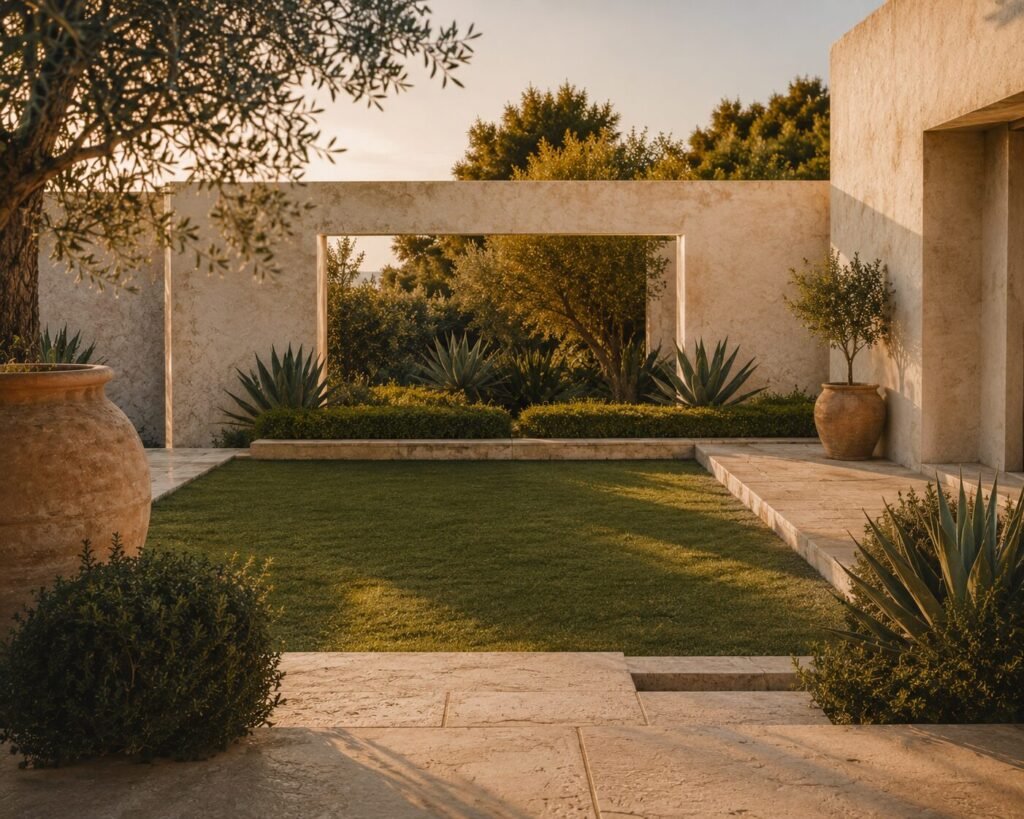
Real lawns have shape, borders, and interruptions. Frame artificial grass with planting beds, stone edging, or gravel. Break it with a path or stepping stones. Put large planted pots on and around it.
Uninterrupted rectangles read as installation. Framed, shaped, planted-around grass reads as garden.
Our iguana approves of artificial grass on precisely one condition: that it is surrounded by enough real plants that nobody thinks about it.
In one line
Mid pile height, multi-tone colour with brown thatch, high density, and a properly built base. Get those four right and nobody will ask.
Garden Design Co. — Ideas, spaces and objects that elevate outdoor living.