
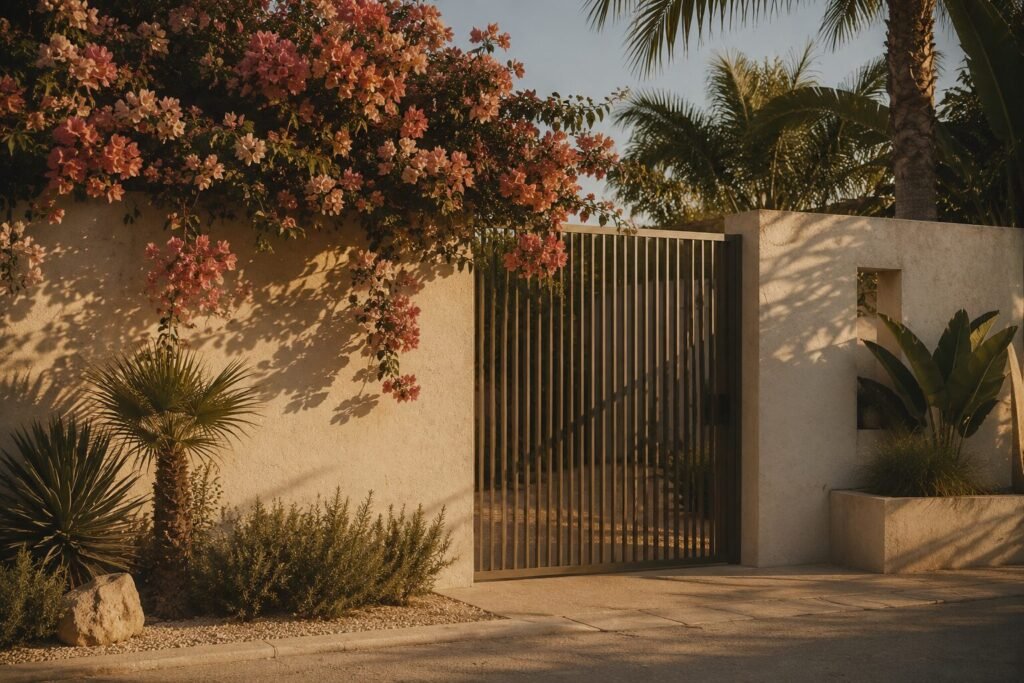
A gate is the handshake of a property.
It is the first thing every visitor touches, the thing seen a hundred times a week from the street, and — almost universally — the last item on the budget. Which is how so many beautiful houses end up behind a gate that has gone chalky, warped, or rust-streaked.
Three materials dominate. Here is what each is actually like to own
Aluminium
What it gets right: it does not rust. Not “resists rust” — does not rust. In coastal environments where salt air destroys steel and warps timber, this single property outweighs almost everything else. Powder-coated aluminium holds its finish for many years with essentially no maintenance beyond an occasional rinse. It is also light, which is a bigger deal than it sounds: light gates are easier on hinges, easier to automate, and less likely to sag.
What it costs you: money up front, and a certain coolness. Aluminum can look excellent — modern slat designs are genuinely handsome — but it will never have the warmth of timber. Powder coating can also chip, and a deep scratch is difficult to repair invisibly.
Buy it if: you are near the sea, you want to install it and forget it, or you plan to automate the gate.
Wood
What it gets right: nothing else has the warmth. A well-made timber gate reads as craft in a way metal rarely does, and it can be built to any dimension by a local carpenter without tooling or import. It also ages beautifully if you let it — silvered hardwood is a legitimate design choice.
What it costs you: attention. Wood moves. It swells in humidity, shrinks in dry heat, and a gate that closed perfectly in March can bind in September. It needs sealing or oiling on a schedule, and in humid or coastal climates, termites and rot are real rather than theoretical.
Hardwood versus softwood matters more than anything else here. A cheap pine gate in a hot, damp climate is a two-to-four-year purchase. A dense hardwood gate is a twenty-year one. The price difference between them is much smaller than the lifespan difference.
Buy it if: you want warmth and character, you have or will build a maintenance habit, and you are choosing a proper hardwood.
Synthetic (composite, vinyl, WPC)
What it gets right: it splits the difference. Modern wood-plastic composites imitate timber convincingly at a distance, do not rot, do not need sealing, and cost less than good aluminium. For a side gate or a service entrance where nobody is examining the grain, it is a sensible, unromantic choice.
What it costs you: honesty. Up close, composite looks like what it is. Cheaper vinyl can also become brittle under years of strong UV, and colour can fade unevenly. Quality varies enormously between manufacturers in this category — more than in wood or aluminium — so brand matters unusually much.
Buy it if: you want low maintenance on a moderate budget and the gate is not the centrepiece of the property.
The part everyone underestimates: hardware
Here is the unglamorous truth of gates. Most gates fail at the hinges and the latch, not the panel.
Undersized hinges on a heavy gate will sag within a year, and a sagging gate scrapes, sticks, and eventually will not latch. Cheap latches seize. Fixings that are not corrosion-rated will bleed rust down whatever they are attached to, ruining the look of a perfectly good gate.
There is also a decision hiding here that most people make on looks alone: swinging or sliding. A swinging gate is cheap to hang. A sliding gate is not — the hardware runs several times the cost before anyone has cut, welded or installed anything. That ratio holds more or less anywhere.
Here is what it looks like in real money. Kooyman Aruba, August 2026, tax included:
| Part | AWG | USD |
|---|---|---|
| Weldable hinge, 3-wing 120mm | 11.99 | 7 |
| Weldable hinge, 2-wing 100mm | 17.99 | 10 |
| Galvanised flat barrel bolt, 160mm | 25.36 | 14 |
| Gate latch, steel | 26.99 | 15 |
| Trolley for hanging gate, 2 ball bearings | 39.99 | 22 |
| Stainless hinge brace, 500mm | 60.89 | 34 |
| Cane bolt, stainless steel | 89.99 | 50 |
| Aluminium rolling rail, 240cm | 109.99 | 61 |
| Box rail, galvanised, 6 ft | 139.99 | 78 |
| Box rail, galvanised, 12 ft | 289.99 | 162 |
Aruban prices. Our freight is in them. Yours will differ; the proportions won’t.
A swinging gate, fully kitted — two hinges, a latch, a cane bolt — comes to around AWG 130 in hardware. The same gate on a twelve-foot slider needs AWG 290 in rail and AWG 80 in trolleys before a single hinge is bought.
Now look at the two bolts. The galvanised barrel bolt is AWG 25.36. The stainless cane bolt is AWG 89.99. Three and a half times the price, and near the sea only one of them is still working in five years. Salt finds galvanised steel through any coating you put on it. Buy stainless for anything that moves, anything that touches the ground, and anything you would be irritated to replace.
Spend disproportionately on hardware. It is a small fraction of the total cost and the overwhelming majority of the failure risk. If a supplier will not tell you the hinge rating, that is your answer.e.
The climate test
Before choosing, ask one question: what does the weather here actually do?
Near the sea, salt air is the dominant force — aluminium wins, steel struggles, timber needs hardwood and diligence.
In humid heat with insects, rot and termites are the dominant force — aluminium or composite for anything in ground contact; hardwood if timber.
In intense dry sun, UV is the dominant force — cheap vinyl becomes brittle, timber needs sealing, powder-coated aluminium barely notices.
The right material is not universal. It is whatever answers the specific thing your climate does to objects left outside.
Our editorial director’s view on gates: the best one is the one you can open with a drink in your other hand. He has never once commented on the material.
In one line
Coastal, automated, or set-and-forget: aluminum. Warmth and character with a maintenance habit: hardwood. Sensible and secondary: composite.
And whichever you choose — buy hinges like the gate depends on them, because it does.