
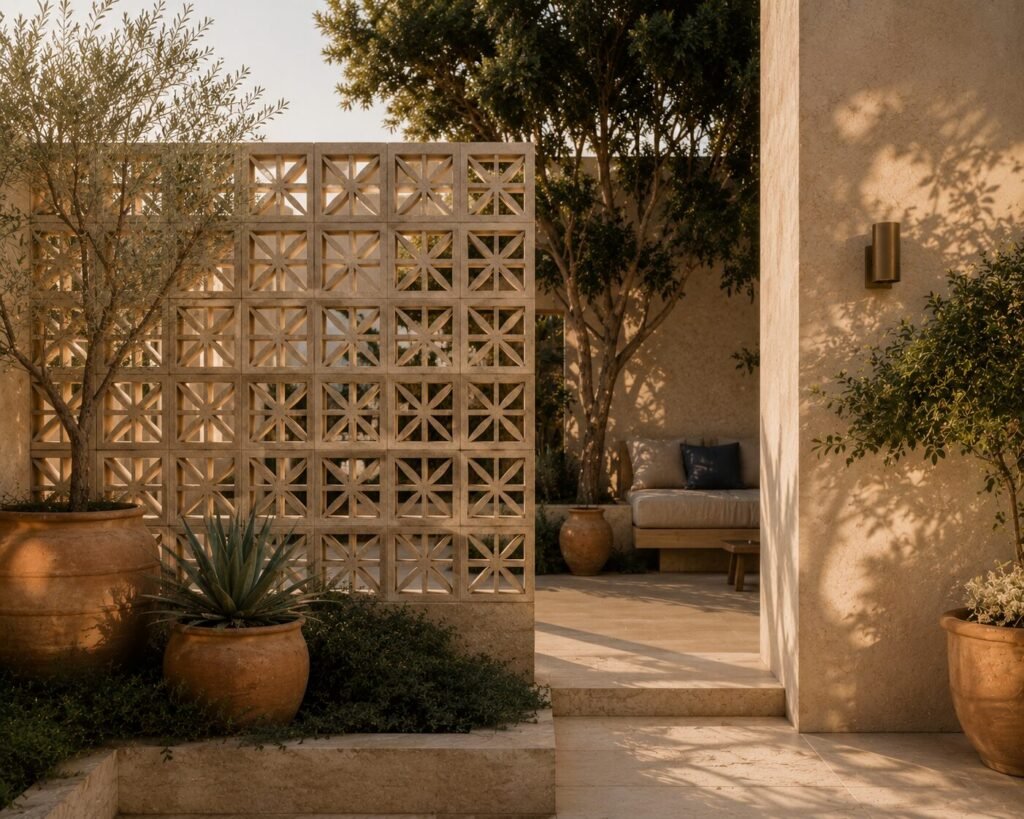
There is a particular kind of failure that happens in outdoor spaces: the yard that is one undifferentiated area.
Everything happens in the same place, or rather, nothing does. There is no sense of arriving anywhere, no reason to move from one part to another, no corner that feels like a corner. It is a space with no rooms.
The obvious fix is a wall. The better fix, almost always, is something you can see through.
Why the breeze block came back
The decorative concrete block — breeze block, celosía, cobogó, depending on where you are standing — was everywhere in mid-century architecture, disappeared for decades into unfashionability, and has returned properly in the last few years.
It came back because it does something walls cannot. It divides space without ending it.
Stand on one side of a breeze-block screen and you get privacy, structure, and the sense of a defined room. But you also get filtered light, moving shadow patterns across the floor, and air passing through. You know the space continues beyond. The division suggests rather than declares.
That is a genuinely difficult effect to achieve, and one modest screen delivers it.
The shadow is the point
Here is what photographs never quite convey: a perforated screen in strong sun turns the ground into a moving artwork.
The pattern shifts through the day, sharpens at midday, stretches long in the late afternoon, and gives the space a sense of time passing. In an outdoor room, that is worth as much as the structure itself.
If you take one thing from this: choose the block pattern by imagining its shadow, not its face. Geometric perforations cast crisp, architectural patterns. Curved and floral ones cast softer, more decorative shadows. Both are correct; they are simply different rooms.
Where dividers earn their place
Between dining and lounging. The most common and most useful application. A low screen or a partial-height divider tells you that the table area and the sitting area are two different rooms, even when they are three metres apart.
Hiding the ugly necessities. Pool equipment, air conditioning units, bins, the storage corner. A screen turns an eyesore into a non-event without sealing it off from access or airflow — and airflow around equipment matters.
Framing an entrance. A short run of blocks beside a gate or path creates a threshold, and thresholds make a property feel considered.
Boundary privacy without hostility. A perforated screen along part of a boundary gives you privacy at seated height while keeping the space open and neighbourly. It is a very different message from a solid wall.
Wind, partially. As we have written elsewhere, permeable barriers break wind better than solid ones. A decorative block screen is a windbreak that happens to be beautiful.
The alternatives to concrete
Breeze blocks are the classic, but the principle — divide with something permeable — has many expressions:
Timber or aluminium slat screens. Lighter, faster to install, no foundation required for freestanding versions. Vertical slats read as modern; horizontal as relaxed.
Metal laser-cut panels. Highly decorative, excellent shadows, and available in patterns that can carry a lot of personality. Best used sparingly.
Planted dividers. Tall grasses, bamboo in containers, or a run of large planters. The softest option, and the one that changes with the seasons. Also the cheapest to try.
Woven and reed panels. Inexpensive, warm in texture, genuinely effective. Shorter lifespan, but a very low-cost way to test whether a division is in the right place before building something permanent.
That last point is worth underlining: test the position with something temporary before you build something permanent. A row of tall potted plants will tell you within a week whether the divide belongs there.
Getting the height right
This is where most dividers fail.
Around 1.2 metres divides visually while everyone remains connected — you can see over it standing, not sitting. This is the height for zoning within a space.
Around 1.8 metres provides genuine privacy and creates a real sense of enclosure. This is the height for boundaries and screening.
Above 2 metres starts to feel defensive, and in a small yard it will feel like a prison wall regardless of how pretty the pattern is.
Partial-height dividers that stop short of the boundary — a screen that is three metres long in a ten-metre yard — often work better than full runs. The gap is what keeps the space breathing.
The restraint rule
Decorative blocks are seductive. The patterns are lovely, the shadows are lovely, and the temptation is to use them everywhere.
Do not. A single screen is architecture. Four screens is a maze, and the pattern that charmed you becomes visual noise.
Current design thinking favours restrained palettes with accents that are measured rather than loud — let form, planting and light lead, and use the decorative element as punctuation. One screen, well placed, in a space otherwise made of plain surfaces and plants.
Our iguana, who spends a good deal of time watching shadows move across a floor, considers the breeze block the most underrated object in outdoor design. He would like exactly one of them, positioned where the late sun hits.
In one line
Divide the space with something you can see through. One screen, at the right height, in the right place — and let the shadow do the decorating.
Garden Design Co. — Ideas, spaces and objects that elevate outdoor living.