
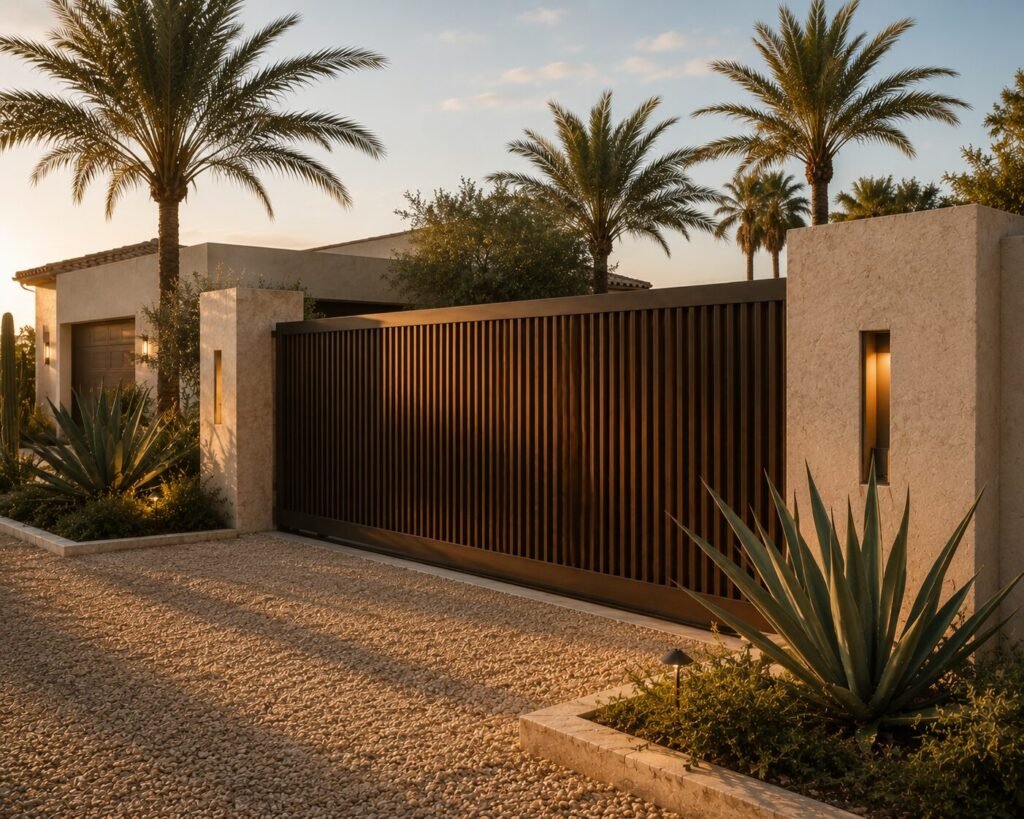
A driveway gate is the largest moving object most people will ever install at home.
It weighs a great deal, it operates several times a day, every day, for years, and when it fails it fails in the most inconvenient way possible — usually with a car on the wrong side of it.
Which is why the decisions here are less about looks than almost anything else in outdoor design.
Sliding or swinging?
Swing gates are the traditional and generally the more attractive option. Two leaves opening inward, a proper sense of arrival. They are usually cheaper to install and mechanically simpler.
But they need swing space — a clear arc, on level ground, unobstructed. On a sloping driveway, swing gates become difficult or impossible without significant groundwork. And they need a deeper setback from the road so that a waiting car is not left sticking into traffic while the gate opens.
Sliding gates need almost no space in front. They run parallel to the boundary, which makes them the answer for short driveways, sloping ground, and tight urban plots. They handle wind better too, since they present less of a sail when opening.
The trade-off is that they need run-off space to one side — roughly the width of the opening again — and either a floor track (cheap, reliable, hates debris and needs a clean channel) or a cantilever system (more expensive, no track, unbothered by ground conditions).
The quick rule: flat ground with room to swing and a deep setback, choose swing. Slope, short setback, or a tight plot, choose sliding.
Material, briefly
Everything in our gates comparison applies here, with one amplification: weight matters much more on a driveway gate.
A heavy timber gate needs a stronger motor, heavier hinges or a beefier track, and larger foundations. Every kilogram increases both the installation cost and the long-term wear on the mechanism.
This is why aluminium dominates automated driveway gates. It is strong, light, and — critically for anywhere near a coast — will not rust. A lighter gate means a smaller motor, less strain, longer life, and quieter operation.
If you want the look of timber with the behaviour of metal, aluminium slat systems in wood-tone finishes have improved considerably.
The automation questions nobody asks until it’s too late
What happens in a power cut?
Every automated gate must have a manual release — a key or lever that disengages the motor so you can push the gate by hand. Find out where it is, and try it, before you need it in the rain at night. Ask about it during the quote, not after the install.
Battery backup is the better answer where power is unreliable, and solar-powered motors have become genuinely practical for gates away from mains supply.
How does a visitor get in?
Intercom, keypad, app, or simply a phone call to you every time. Decide this early, because it affects the cabling that gets buried during installation. Retrofitting a cable under a finished driveway is an expensive regret.
What stops it closing on something?
Safety sensors are not optional. A photocell beam across the opening stops the gate if anything interrupts it, and obstruction detection reverses the motor if the gate meets resistance. On a gate that weighs a couple of hundred kilos and closes automatically, with children or pets around, this is the part of the specification not to economise on.
What is the duty cycle?
Motors are rated for how frequently they can operate. A motor sized for a quiet residential gate will fail early on a busy household with several cars coming and going all day. Tell the installer honestly how often it will run.
Garage doors: the same logic, indoors
Sectional doors — panels that fold up and back along the ceiling — are the modern standard. They take no space outside, seal well against weather and insects, and allow you to park right up to the door.
Roller doors are compact, coiling into a drum above the opening, and excellent for low headroom or tight garages.
Up-and-over (tilt) doors are the cheapest and swing outward as they open, which means keeping clearance in front — the same problem as swing gates, in miniature.
Two things matter more than the type: insulation, if the garage adjoins living space or you use it as a workshop; and the same safety and manual-release considerations as any automated gate.
The maintenance nobody does
An automated gate is a machine, and machines want attention.
Twice a year: clear the track or channel of debris, check that fixings have not loosened from vibration, lubricate moving parts with the right product, test the safety sensors by interrupting the beam, and test the manual release.
This takes twenty minutes and it is the difference between a gate that lasts fifteen years and one that needs an emergency call-out in year four.
And the same rule holds as with all contractors: whoever installs it should have a real address you can return to, because you will need them again — for service if not for repair.
In one line
Sliding for tight or sloping sites, swinging for open ones. Choose the lightest material that suits the look, never economise on safety sensors, and find the manual release before you need it.
Garden Design Co. — Ideas, spaces and objects that elevate outdoor living.