
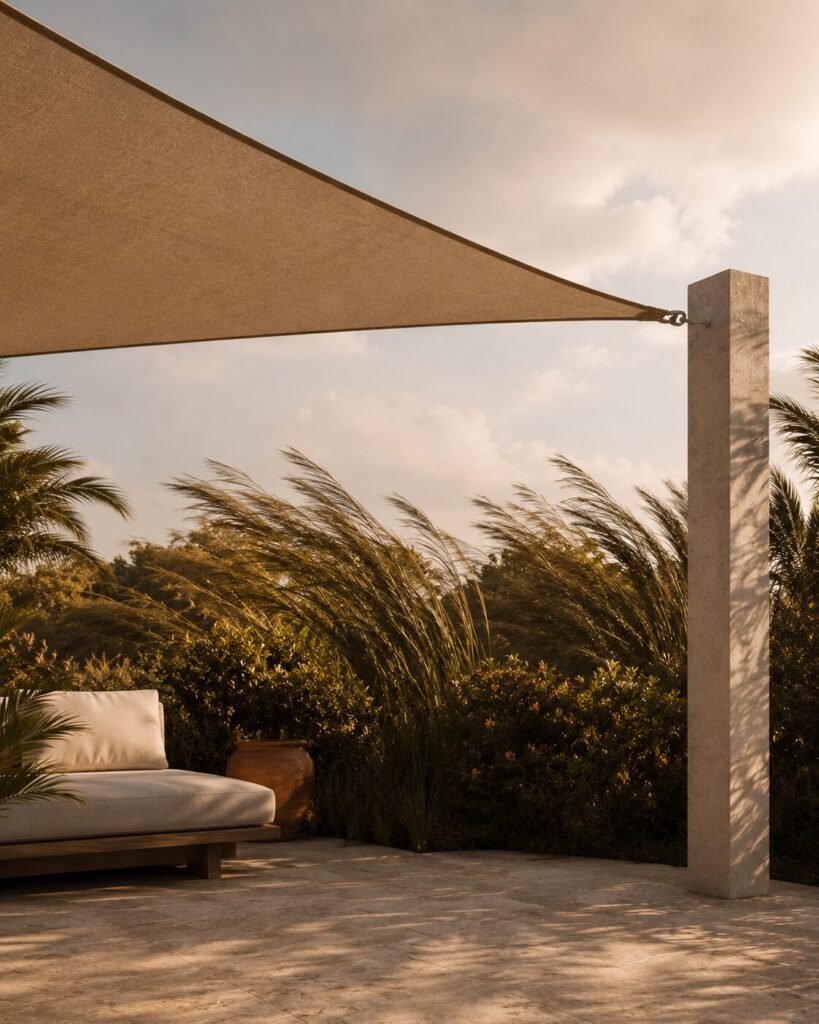
The trade winds here don’t gust. They blow — steady, all day, fifteen to twenty-five knots, the kind of wind that bent every divi-divi tree on the island into the same permanent bow. It’s why Aruba has almost no mosquitoes, and why your neighbor’s shade sail is currently somewhere at the bottom of his pool.
Short answer, up front: shade sails can survive constant trade wind, but only with marine-grade hardware and wind-rated fabric — otherwise a fixed pergola will outlast one every time. Here’s what that actually means once you’re standing in a hardware store trying to decide.
If you’re shading a patio anywhere the wind doesn’t take a day off — Aruba, Curaçao, the windward coast of any Caribbean island — the question isn’t which structure looks best. It’s which one is still attached to your house in October.
Shade sails: cheap, fast, and the first thing to fail
A shade sail sounds like the obvious answer. It’s inexpensive, ships flat, and a local installer can have it up in an afternoon. For a courtyard tucked out of the wind, or a spot that only needs shade for a few hours around a specific meal, it’s genuinely a good call.
The problem is what “wind rated” means on the packaging versus what it means at twenty knots sustained, every day, for years. Most commercial shade sails are rated for occasional gusts, not constant load. A sail engineered for a mild climate is under real, continuous strain here — and the failure point usually isn’t the fabric. It’s the hardware. Cheap turnbuckles and undersized eye bolts pull straight out of stucco within a season or two, and once one corner goes, the rest follows fast.
If you go the sail route, the fix is boring but it works: marine-grade stainless hardware, posts set in concrete rather than mounted to a wall, and fabric rated for genuinely constant wind load — not the standard residential spec sold everywhere online. It costs more upfront. It’s also the difference between a shade structure and a $200 lesson.
Pergolas: the wind-honest option
We’ve written before about Pergolas: The Structure That Makes a Yard Make Sense, and constant wind is exactly where that advantage shows up. A pergola doesn’t billow, doesn’t luff, and doesn’t need re-tensioning every few months. Wind moves through the slats instead of loading up a sheet of fabric like a sail — which, unhelpfully, is exactly what a shade sail is built to be.
The trade-off is cost and permanence. A pergola is a construction project, not a weekend fix, and once it’s built you’re not moving it. If you’re renting, or you’re not sure yet where the sun actually falls on your patio through a full year, that permanence can work against you.
What actually works here
The honest answer, most of the time, is a hybrid. Fixed shade over the zone you use daily — dining table, outdoor kitchen, wherever people actually sit — with a sail or retractable canopy over the more flexible zones, sized down and hardware-upgraded so it survives. If you’ve read Wind Is Why You Don’t Use Your Patio, you already know the instinct to over-engineer the fix is the right one here too. Skimping on hardware to save forty dollars on a turnbuckle is how you end up replacing the whole structure at year two instead of year ten.
Local contractors who’ve actually built for this wind are worth more than a lower quote from someone who hasn’t. Ask what they’ve built that’s still standing after three years of full trade wind exposure — not what they can install this week. Imported hardware also matters more than people expect: a stainless kit that shipped in with the right marine rating outlasts the galvanized version sold locally, even though it costs more to bring in.
Dividing and shading together
If the goal is shade and privacy — a courtyard that needs both — pair a partial shade sail with Breeze Blocks and the Art of Dividing Space instead of a solid wall. The gaps let wind pass through rather than load up against a flat surface, which is the same principle that makes a pergola outperform a sail in the first place: let the wind through, don’t fight it.
Our iguana has strong feelings about shade, mostly that he needs some and would rather not discuss the engineering behind it. He has, however, noticed that the neighbor’s shade sail now lives in the pool, and he’s not in a hurry to make the same mistake.
FAQ
Do shade sails work in high-wind areas like Aruba?
Yes, but only with marine-grade hardware, posts set in concrete, and fabric rated for constant load rather than occasional gusts. Standard residential shade sails typically fail at the hardware within a season or two.
Is a pergola better than a shade sail in constant wind?
For a spot you use daily, yes — a pergola is a fixed structure that doesn’t billow or need re-tensioning. For flexible or seasonal shade, an upgraded sail can still hold up.
How much more does wind-rated shade hardware cost?
Meaningfully more than a standard kit — but it’s usually the difference between a structure that lasts one season and one that lasts a decade.
In one line
In constant wind, shade isn’t about the fabric — it’s about what’s holding it down.
Garden Design Co. — Ideas, spaces and objects that elevate outdoor living.