
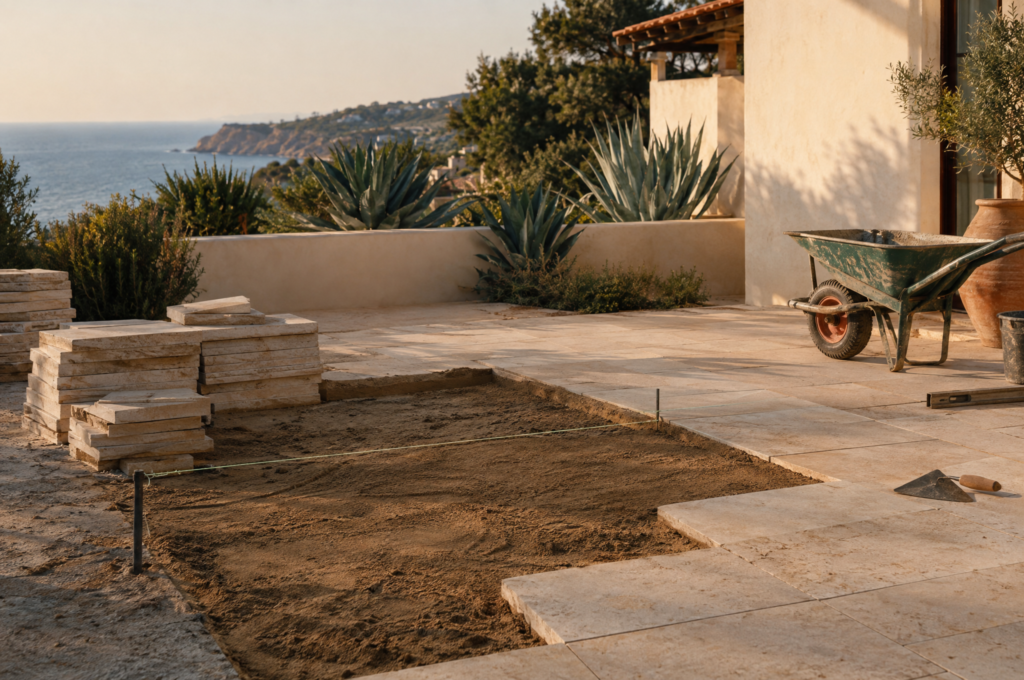
Most outdoor projects here do not fail on design. They fail on the calendar. A pool deck quoted for six weeks becomes four months, and nobody lied to you — they just didn’t tell you about the parts that were never really theirs to promise.
The honest answer: budget three to six months for anything that involves imported material, a permit and a licensed contractor, even on a project that would take three weeks on the mainland. The gap isn’t laziness. It’s three separate clocks running at different speeds — shipping, permitting and labor — and almost every delay comes from someone assuming they run at the same pace.
The shipping clock is the one people forget to start
Anything not sold on-island — a specific porcelain tile, a pump with the right voltage, hardware that isn’t the local big-box default — ships from Florida, the Netherlands or China. Ocean freight to Aruba or Curaçao typically runs four to eight weeks port to port, and that’s before customs clearance, which adds another one to three weeks depending on the week, the port, and whether your paperwork matches your invoice exactly. Air freight cuts that to days but at three to five times the cost, which is the trade-off nobody wants to make until they’re staring at an empty patio the week before a party.
The fix isn’t heroics. It’s ordering the long-lead items — tile, fixtures, specialty hardware — before the contractor even breaks ground, based on final drawings, not final vibes. Changing your mind after the container ships costs you the whole clock again. We broke down what that shipping actually adds to a bill of materials in The Rule of Three: What Importing Actually Costs Here — the same math applies to time, not just money.
The permit clock runs on paper, not urgency
Aruba, Curaçao and Bonaire each have their own building department, their own forms and their own patience for follow-up calls. None of them move faster because your contractor is available next week. A straightforward pool or pergola permit can clear in two to four weeks if the drawings are complete on the first submission — and it can stretch to two months if they aren’t, because you go to the back of the queue, not the front, when something bounces back for correction.
This is where a contractor who has pulled permits here before earns their fee. We wrote about vetting that upfront in How to Choose a Contractor You Can Actually Trust — ask specifically how many permits they’ve filed with the local department this year, not how many years they’ve been in business.
The labor clock is the shortest window and the least flexible
Good outdoor crews on a small island are a finite resource, booked out weeks or months, especially from December through April when everyone with a winter guest list wants their patio finished. A crew that tells you “we can start in six weeks” isn’t being difficult. They’re being honest about a calendar that has maybe four capable teams on it, not forty.
This is also where exposure matters more than most people expect — a site three hundred feet from the water needs different substrate prep, different fixings and often a different crew’s specialty than one set back in a courtyard. We laid out how to read your own site’s exposure in How Far From the Sea Are You?, and it’s worth doing before you call anyone, because the answer changes who you should even be calling.
What actually shortens the timeline
Order long-lead materials against final drawings, not preliminary ones. Submit permits complete the first time — pay a draftsperson if that’s what complete requires. Book your contractor’s slot before the material even lands, so the two clocks finish close together instead of one waiting on the other. And build in a buffer for the thing nobody can plan for, which on these islands is usually a shipping delay, a permit officer’s holiday, or both in the same month.
None of this is exotic advice. It’s the same three questions asked in the same order, every time: what’s shipping, what’s permitted, who’s building. The projects that come in close to schedule are the ones where all three started on day one instead of in sequence.
We asked our resident iguana how long his pool deck took. He hasn’t ordered anything, hired anyone, or moved from that rock since March — and he seems fine with it.
In one line
The materials, the permit and the contractor all run on different clocks — start all three on day one, and the project you were quoted is roughly the project you’ll get.
FAQ
How long does it take to build a pool or patio in Aruba, Curaçao or Bonaire?
For a project with imported materials and a permit, plan on three to six months from signed design to finished space. Simple, locally-sourced work without a permit can move in a few weeks; anything shipped and permitted rarely does.
Why do outdoor projects in the Caribbean take longer than quoted?
Most quotes price the labor, not the shipping or permitting clocks running alongside it. Delays usually come from ordering materials after the contractor starts, or submitting incomplete permit drawings that get sent back for correction.
Should I order materials before or after hiring a contractor?
Order long-lead items — tile, fixtures, specialty hardware — against final drawings as soon as the design is locked, ideally before the contractor’s crew is scheduled to start. Waiting until they’re ready to install usually adds the full shipping window to your finish date.
Garden Design Co. — Ideas, spaces and objects that elevate outdoor living.