
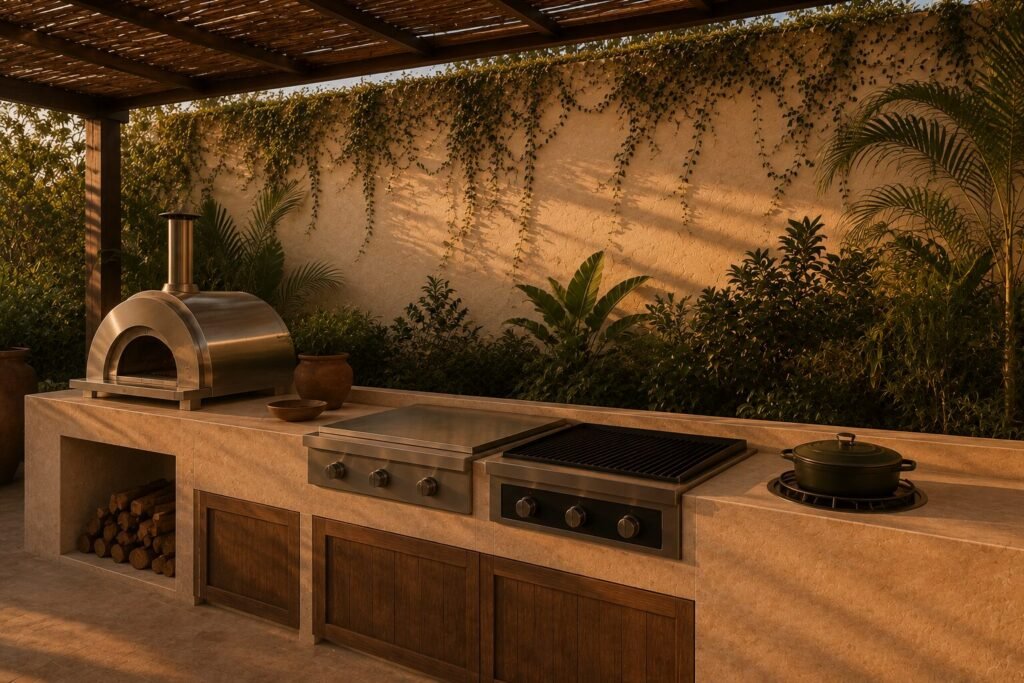
The pizza oven is the most photographed object in outdoor living and the least used.
That is not an argument against pizza ovens. It is an argument for a different starting question. Most outdoor kitchens are designed around the appliance someone fell in love with online, and then quietly reorganised, a year later, around the one thing that actually gets switched on every week.
Short answer, up front. If you cook outside once or twice a week, you want a grill and a flat top. If you cook for a crowd and the cooking is the evening, you want an open fire. If you fry, boil or make anything in a pot, you want a burner more than anything else on this list. And if you want a pizza oven, buy one — but buy it knowing what it asks of you.
The grill is the default, and usually correct
Gas or charcoal is the oldest argument in outdoor cooking and it still comes down to the same trade: gas buys you Tuesday, charcoal buys you Saturday.
A gas grill is lit and ready in ten minutes. That single fact is why gas grills get used far more often than charcoal ones in the same household. Charcoal takes thirty to forty minutes to a proper bed of coals, and rewards you with something gas cannot fake.
The coastal caveat matters more here than anywhere else. Cheap grills sold as stainless are usually 430 grade, which will show rust within a year of salt air. 304 is the sensible minimum near the water; 316 is marine grade and worth the difference if you are within sight of the sea. A powder-coated cart with a 316 cooking surface will outlast a cheap full-stainless unit by years.
The open fire is the one people gather around
The Portuguese-style hearth — a masonry alcove with a chimney and a grill you raise or lower over the embers — is a different proposition entirely. It is not an appliance. It is architecture that happens to cook.
What you get is control by height rather than by dial, wood smoke no gas grill approximates, and a fire that holds people in one place for four hours. What you give up is spontaneity. You are building masonry, you need a wood supply, and on an island a reliable wood supply is harder to arrange than people expect.
Orientation is the thing most people get wrong. Where the trade winds are constant and directional, a hearth placed on the wrong side of the terrace sends smoke straight through the dining table every single night. Not occasionally — every night. This is the same problem we covered in Wind Is Why You Don’t Use Your Patio, and it has the same answer: work with the prevailing wind instead of pretending it is not there.
The plancha earns its keep
The flat top is the least glamorous surface here and the one that gets used most.
Everything that falls through a grate belongs on a plancha: whole fish, prawns, onions, peppers, eggs, arepas, smash burgers, anything for breakfast. If you live somewhere the fish comes in fresh and whole, this is not a nice extra — a snapper on a grate is a wrestling match, and a snapper on a plancha is dinner.
The trade-off is honest: no char, no smoke flavour, and a surface that needs seasoning and drying. Carbon steel cooks better and rusts faster. Stainless is more forgiving in humid, salty air but never quite develops the same surface. Near the coast, dry it and oil it the same evening you use it, not the next morning.
The burner is unglamorous and unmissable
Nobody photographs a burner. Then they build an outdoor kitchen without one and spend two years wishing they had not.
A high-output ring burner is what you need for a pot: rice for twelve, a stew, boiling crab, and — the real reason — frying fish outside instead of inside. Anyone who has fried fish in a closed house understands this as a structural argument rather than a culinary one.
It is also the cheapest item on this list by a wide margin, which makes it the easiest thing to add later. If budget forces a phased build, the burner is the least painful thing to postpone and the most satisfying thing to finally install.
The pizza oven, honestly
A wood-fired dome at full heat cooks a pizza in ninety seconds and does things to bread, roast vegetables and whole fish that nothing else here can. That is real.
What is also real: forty-five to sixty minutes of preheat, a fuel supply, and a piece of equipment that in practice does one thing. The maths only works if you use it weekly. Used weekly, it is the best thing in the garden. Used four times a year, it is a very expensive sculpture with a chimney.
Gas-fired pizza ovens are the honest compromise — twenty minutes to temperature, no wood to source, and a result close enough that only you will know. Portable models have made this a decision you can reverse, which is worth a great deal on a terrace you are still learning how to use.
What actually makes it a kitchen
None of the above. The heat source is the fun part of the decision and the smallest part of whether the space works.
What makes it a kitchen is counter space on both sides of the heat, somewhere to put things down, shade over the cook, storage that closes, and water within a few steps. An outdoor kitchen without a landing surface is a barbecue with ambitions.
Shade over the cooking zone is not optional in this climate, and it is worth reading Pergolas: The Structure That Makes a Yard Make Sense before you decide where the counter goes — the structure and the kitchen should be designed together, not one retrofitted around the other. For the surfaces themselves, terracotta stays notably cooler underfoot than sealed concrete, which matters when you are standing in one spot for an hour.
Build the counter first and you can add heat sources for a decade.
FAQ
What is the best heat source for an outdoor kitchen?
For most people, a gas grill paired with a flat top. The grill handles weeknights, the plancha handles everything that falls through a grate — including whole fish.
Are pizza ovens worth it?
Only if you will use one weekly. Preheat takes forty-five to sixty minutes for wood-fired, twenty for gas. Used four times a year it is an expensive ornament.
What grade of stainless steel survives salt air?
304 is the minimum near the coast; 316 is marine grade. Cheap grills labelled stainless are often 430 and will rust within a year.
In one line
Buy the heat source you will use on a Tuesday, and build the counter that lets you add the others later.
Garden Design Co. — Ideas, spaces and objects that elevate outdoor living.