
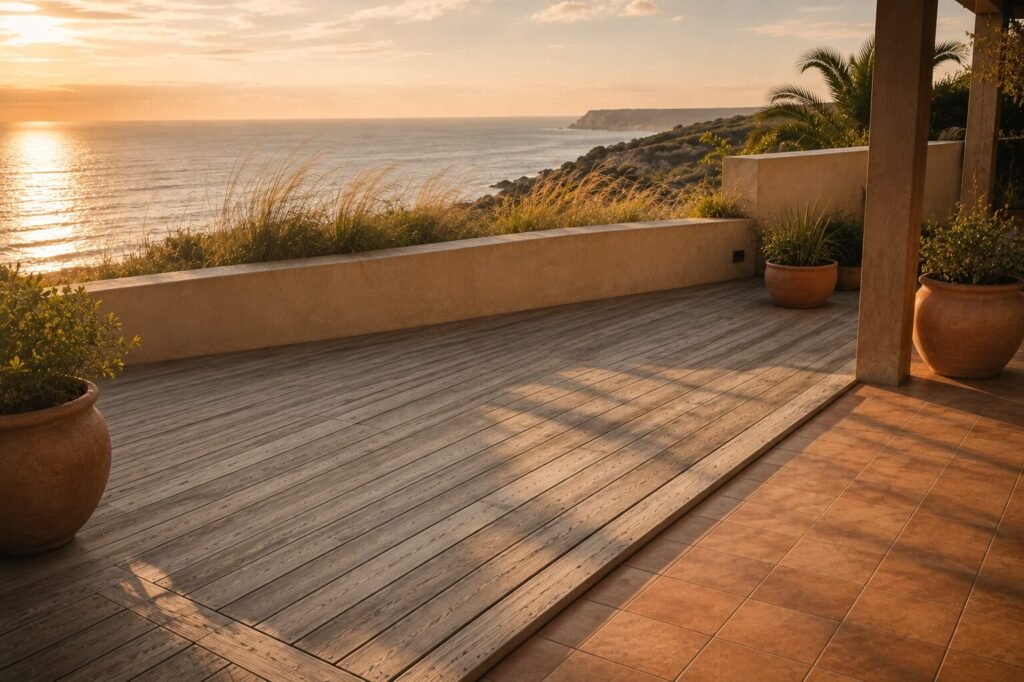
Composite decking gets recommended the moment someone mentions salt air, and about half the time it’s the wrong call. The honest answer: pressure-treated pine is the cheapest and the first to fail here, tropical hardwood like ipe or teak is the most expensive and the longest-lived, and composite sits in the middle, trading a real wood feel for a maintenance schedule of almost zero. None of the three wins on price, looks and low maintenance at once. What actually decides it is how long you plan to own the house, and how much you enjoy sanding.
There’s a boardwalk near Eagle Beach that got redone twice in six years before someone finally called a contractor who had installed decking somewhere humid before. That’s the real lesson before any material comparison: on an island, the installer matters as much as the species.
Tropical hardwood: the material built for exactly this
Ipe, teak, cumaru — dense tropical hardwoods are, structurally, decking that evolved for humidity and insects before anyone milled it into a board. Left unsealed, it silvers to a soft grey that looks intentional rather than neglected. Left oiled, it holds its honey tone for years. Either way it resists rot and termites better than almost anything else you can walk on barefoot.
The catch is supply and price. Very little of it is grown regionally, so it arrives by container from South America or Southeast Asia, and container schedules don’t care about your renovation timeline. Budget six to twelve weeks and order extra for the boards that arrive with hairline splits from the trip. It’s also dense enough to blunt ordinary screws — pre-drilling every hole isn’t optional, it’s the job.
Composite: the low-maintenance compromise
Composite decking — wood fiber bound in recycled plastic — doesn’t rot, doesn’t need oiling, and doesn’t care about termites at all. For a rental property or a second home that sits empty for stretches, that’s close to the whole argument. It also runs noticeably hotter underfoot than real wood in full sun, and the early-generation boards that gave composite a bad name for fading and staining are mostly a decade behind current products.
The trade-off nobody mentions in the brochure: composite is a manufactured product with a manufactured look up close, and it isn’t repairable the way wood is. A scratch or a burn mark is there permanently. It also still needs a properly ventilated substructure underneath, because trapped moisture will rot the frame even if the boards themselves are indifferent to it.
Pressure-treated pine: the honest starting point
Pine is the material most people start with and the one that asks for the most attention afterward. It’s a fraction of the cost of hardwood or composite, which makes it the right call for a first deck, a temporary structure, or a budget that has already gone to the pool. In a humid, salt-heavy climate, though, it wants resealing every twelve to eighteen months, and the coating that protects it against rot does very little against warping — pine boards cup and twist here faster than the treatment label suggests.
If pine is the plan, spend the savings on stainless steel or coated fasteners rather than the cheapest screws in the hardware aisle. Standard galvanized hardware corrodes and stains the boards around it within two or three seasons of trade wind salt spray — a problem that shows up as rust streaks radiating from every screw head, and it’s one of the most common decking complaints local contractors hear.
What is actually under the boards
Every material comparison skips the part that determines whether any of it lasts: the substructure. Joists need real airflow underneath, not a deck built flush to grade where water sits after a squall. Fastener choice matters as much as board choice. And decking that adjoins a patio should be planned alongside the flooring decision, not after it — the tile-versus-stone question we covered for patios applies to the transition detail between deck and pavers, and getting that seam wrong is where most water damage starts.
Shade changes the calculation too. A deck under a pergola runs cooler and the boards last longer, since UV breakdown ages a deck as much as moisture does. And if the site catches real wind off the water, it’s worth reading what we found about wind and unusable outdoor space before finalizing where the deck goes, since an exposed deck in a wind corridor takes more sun-and-salt exposure than a sheltered one.
What it actually costs to get decking here
Landed cost is rarely what the first quote says. Hardwood and composite both typically arrive by container, and freight, duty and a broker’s fee can add thirty to fifty percent on top of the mill price before a single board touches the island. Pine is more often available through local suppliers already carrying stock, which is part of why it stays the default even where it isn’t the best material.
The move that saves the most money is the same one that applies to every imported material here: price the boards and the hardware separately from the installation labor, and get more than one contractor’s read on what a container of a given species actually costs landed. A quote that bundles everything into one number is a quote you cannot negotiate.

The iguana, notably, has never once helped carry a container off a truck, but he has strong feelings about splinters and refuses to lie down on anything that hasn’t been sanded properly.
Frequently asked
Does composite decking get too hot to walk on in the Caribbean?
Yes, more than natural wood in full sun — lighter colors and a shaded installation under a pergola or sail reduce this significantly.
Is tropical hardwood decking worth the cost over composite?
If you’re staying long-term and want a repairable, ageing-gracefully material, yes; if the property sits empty for stretches or you want near-zero maintenance, composite is the better trade.
How often does pressure-treated pine decking need to be resealed in humid climates?
Every twelve to eighteen months for the coating, though warping from humidity happens regardless of how well it’s sealed.
In one line
There is no decking material that is cheap, low-maintenance and beautiful at once here — pick the two you actually need and budget honestly for the third.
Garden Design Co. — Ideas, spaces and objects that elevate outdoor living.