You plant the bougainvillea hedge the landscaper showed you in the catalog. Three months later it’s alive but sulking — half the leaves gone, blooms thin, and you’re running the drip line twice a day just to keep it upright. Meanwhile the divi-divi tree nobody planted, the one that’s been leaning sideways at the edge of the property since before the house was built, hasn’t had a drop of extra water in years and looks better every dry season.
Here’s the answer, plainly: in Aruba, Curaçao and Bonaire, native and long-naturalized plants will outperform imported ornamentals on every metric that matters — survival, water use, and how they look after year two. Imported plants can absolutely work here, but only with irrigation, soil amendment and maintenance budgets most homeowners underestimate by half. The trade wind and coral soil aren’t obstacles to work around. They’re the actual conditions your garden has to answer to.
Coral Soil and Constant Wind Change the Math
Mainland gardening advice assumes soil that holds water and air that doesn’t move eighteen hours a day. Neither is true here. Coral-derived soil drains almost as fast as you pour, holds little organic matter, and turns to dust in the dry months between January and September. The trade wind that makes an evening on the terrace bearable also strips moisture off every leaf surface it touches, which is why an imported plant bred for humidity looks scorched within weeks of going in the ground, even when it’s watered on schedule.
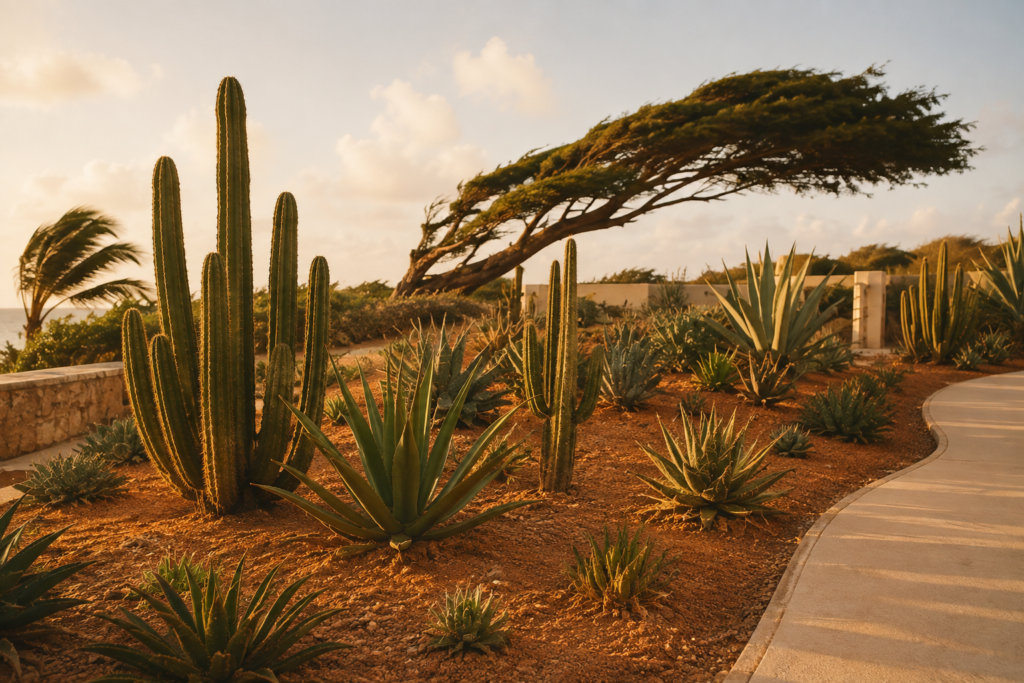
Plants that evolved here — or arrived centuries ago and adapted hard — solved this problem before you bought the property. Kadushi and other columnar cacti store water in their own tissue. Watapana (divi-divi) grows a root system wide enough to find whatever moisture the soil is holding, which is also why it grows sideways, permanently combed by the wind rather than fighting it. Aloe, agave and most euphorbias close their pores during the hottest part of the day to cut water loss. None of this is designed. It’s just what survived here long enough to become the landscape.
What Actually Thrives
For structure, kibrahacha and watapana are the two trees that ask almost nothing of you once established — kibrahacha’s yellow bloom after rain is genuinely spectacular and lasts only a few days, which is part of the appeal. For ground cover and borders, look at various Aloe and Agave species, plus the native cacti (kadushi, prickly pear) if you want something that reads as sculptural rather than just tough. Sea grape (druif) works well as a windbreak near the coast and tolerates salt spray that would kill most imported hedging outright.
Bougainvillea deserves a mention because it’s not native and everyone plants it anyway — it’s naturalized well enough over decades that it behaves more like a local than an import, provided you choose the older, tougher cultivars over the newer compact varieties bred for pot displays in cooler climates. It’s the same logic behind a low-maintenance garden built around what already wants to grow: work with the plant’s instincts, not against them.
The Honest Trade-Off
Native planting is not the lush, layered look you see in a Bali resort or a Miami courtyard, and pretending otherwise sets up disappointment. It reads as sparser, more architectural, more silver-grey and less deep green. If a full green lawn is the one thing you won’t compromise on, artificial grass built to survive the trade wind is worth reading before you commit either way — it solves the lushness problem without the irrigation bill. For everything else, budget the fuller tropical look as a maintenance line item, not a one-time planting cost: drip irrigation on a timer, soil amendment every year or two since coral soil doesn’t build organic matter on its own, and accepting that some percentage of imported stock won’t make it through the first dry season no matter how carefully it’s planted.
Import costs compound this. A palm or flowering shrub shipped in from Florida or the Netherlands has already survived one stressful transition before it ever reaches your soil, and local nurseries mark up accordingly for the loss they expect. Ask any nursery on the islands what percentage of an imported shipment they lose before it’s even sold — the honest ones will tell you, and it’s higher than you’d guess. That cost gets passed to you either in price or in replacement plants six months later.
This isn’t an argument against ever importing anything. It’s an argument for being deliberate about where you spend that budget — a handful of imported specimen plants near the entrance or pool deck, potted in terracotta rather than planted straight into coral soil so they’re easier to water, move and eventually replace, surrounded by a native structure that doesn’t need the same attention.
Curaçao and Bonaire share this arithmetic almost exactly with Aruba — same coral base, same trade wind, same dry-season math. If you’re gardening in St. Maarten, Saba or St. Eustatius, much of this doesn’t apply the same way; more rainfall and richer soil mean imported tropicals have a real shot without the irrigation budget the ABC islands demand.
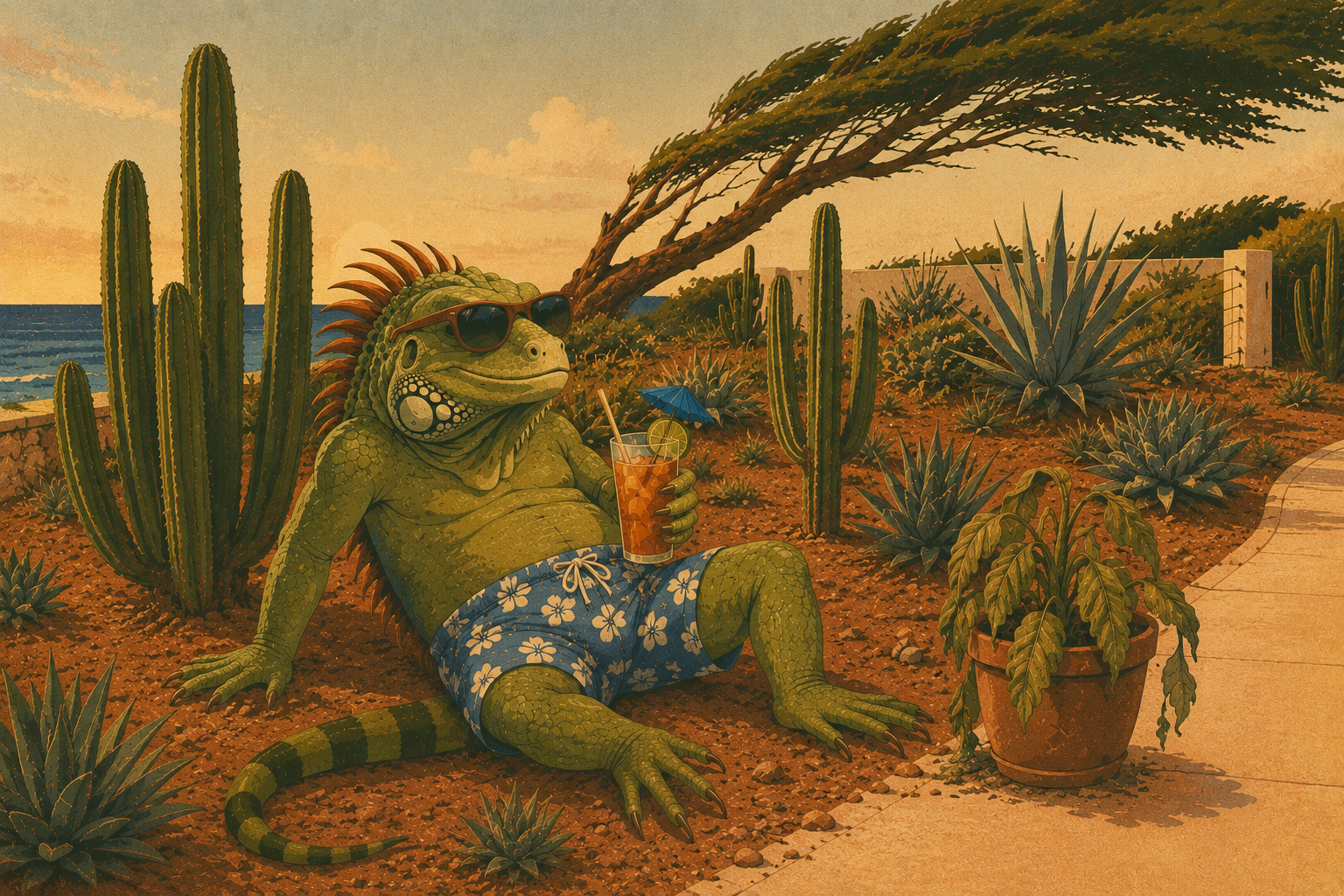
Our resident iguana has never once been spotted near a bougainvillea hedge. He suns himself on the kadushi bed instead, unbothered, because nothing there needs his help to survive.
Frequently Asked Questions
Do native plants look as lush as imported tropical plants?
Not usually. Native planting in the ABC islands reads more sculptural and silver-grey than deep green — but it survives without irrigation, which imported tropicals generally can’t.
Can I still plant bougainvillea or imported palms in Aruba?
Yes, if you budget for irrigation and accept that some won’t survive the first dry season. Treat them as accent pieces near the house, not the backbone of the garden.
Is gardening in Curaçao and Bonaire different from Aruba?
Barely — same coral soil, same trade wind, same dry-season math. St. Maarten, Saba and St. Eustatius get more rain and can support more imported greenery without the same irrigation budget.
In One Line
Plant native first for structure that survives on its own, then spend your import budget on a few specimens you’re willing to actually water.
Garden Design Co. — Ideas, spaces and objects that elevate outdoor living.