
Six months. That’s roughly how long it takes a big-box solar spotlight to give up out here — the plastic lens goes cloudy, the battery swells, and the stake snaps off in your hand the first time you try to move it. We’ve watched it happen to three different gardens on three different streets, and every time the owner says the same thing: it looked fine in the store.
Garden lighting in the ABC islands has to survive conditions most lighting was never designed for: constant salt-laden trade wind, UV that bleaches plastic in a season, and — on Aruba and Bonaire especially — coral soil that makes digging a trench for wiring its own small project. The short answer, if you only read one paragraph: low-voltage wired systems with marine-grade fittings last the longest and cost the least over five years, solar works only for accent lighting you don’t mind replacing annually, and hardwired line-voltage is worth it solely for anything structural — a pergola, a gate, a driveway — where you’d need an electrician regardless.
Low-voltage wired: the workhorse
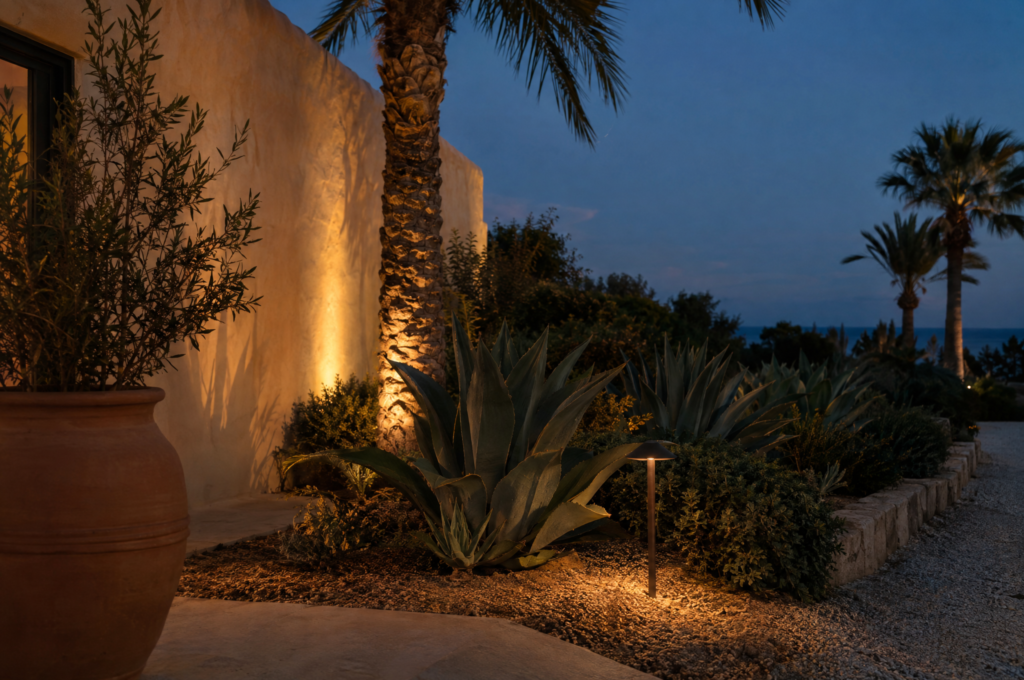
A transformer plugged in near the house steps household current down to 12 volts and sends it out through a run of cable, usually buried a few inches under mulch or paver joints. This is what most professional installers use here, and for good reason — 12 volts won’t hurt you or the dog, the cable can be cut and re-spliced without an electrician, and marine-grade brass or stainless fixtures shrug off salt air for years instead of months.
The catch is upfront cost and installation time. A decent kit with six to eight fixtures, transformer and cable runs $250–500 imported, before you’ve paid anyone to dig. In coral soil that digging is slower than the mainland tutorials assume — budget for a full day, not an afternoon, if you’re doing it yourself.
Solar: fine for accents, not for anything you rely on
Solar has an obvious appeal here — we have sun almost every day of the year, and no cable to bury. But the sun that charges the panel is the same sun that cooks the lithium battery sitting a few inches below it, and heat is what kills these batteries faster than the advertised lifespan suggests. Add trade wind knocking cheap stake-mounted units sideways into the soil, and most solar lights are visibly failing by month eight.
Use solar where failure is low-stakes: marking a path edge, a bit of glow along a low garden wall, somewhere a dead light for a few weeks isn’t a problem. Don’t rely on it to light a step, a pool edge, or anything where losing the light matters. And buy fixtures rated for genuine outdoor marine use — the difference between a $12 stake light and a $35 one is usually the difference between six months and three years.
Hardwired line-voltage: only when you already need the electrician
Full 120V garden lighting — wired straight into the house circuit, no transformer — makes sense almost nowhere in a residential garden except when you’re already running that wire for something else. If you’re wiring a pergola for a fan or outlet, or automating a gate, adding a couple of hardwired uplights to the same run costs little extra and gives you fixtures that will outlast the low-voltage alternative by a decade. Outside of that, it’s a licensed-electrician job for a benefit low-voltage already delivers at a fraction of the cost.
If a contractor quotes hardwired lighting as the default for a straightforward garden, ask why — it’s the kind of upsell worth a second opinion, the same instinct we’d bring to any contractor conversation.
What actually goes wrong here
Almost every lighting failure we’ve seen locally traces back to one of two things: fixtures rated for “outdoor use” in a climate that means occasional rain, not year-round salt spray, or wiring buried too shallow and pulled loose by wind-driven erosion around the coral base layer. Marine-grade — actual marine-grade, not the word used loosely in a listing — is the one spec worth paying up for. Everything else is negotiable.
Fixtures worth having also tend to be imported, which brings its own math. If you’re already bringing in a container for a bigger project — a pergola build, say — it’s worth adding a lighting kit to that same shipment rather than ordering it separately later. The freight and duty split across more items instead of landing on one; see our breakdown of what importing actually costs here for the real numbers.
The iguana has opinions on none of this, technically, since he doesn’t pay the electric bill. But he’ll tell you the porch light left on all night doesn’t do the garden any favors either — moths, mostly, and a slightly worse view of the stars he’s fond of.
Frequently asked questions
Does solar garden lighting work in the Caribbean?
For accent lighting, yes — for anything you rely on, no. Constant heat degrades the battery faster than the rated lifespan, and trade wind knocks over cheap stake mounts within months.
What’s the most durable type of garden lighting for salt air climates?
Low-voltage wired systems with genuine marine-grade brass or stainless fixtures. They cost more upfront but outlast solar by years and don’t carry line-voltage’s installation cost.
Do I need an electrician to install garden lighting?
Only for hardwired 120V systems. Low-voltage 12V systems can be installed and re-spliced without one, which is why most local installers default to them.
In one line
Go low-voltage wired for anything that matters, keep solar for accents you can lose, and only go hardwired if the electrician’s already there for something else.
Garden Design Co. — Ideas, spaces and objects that elevate outdoor living.