
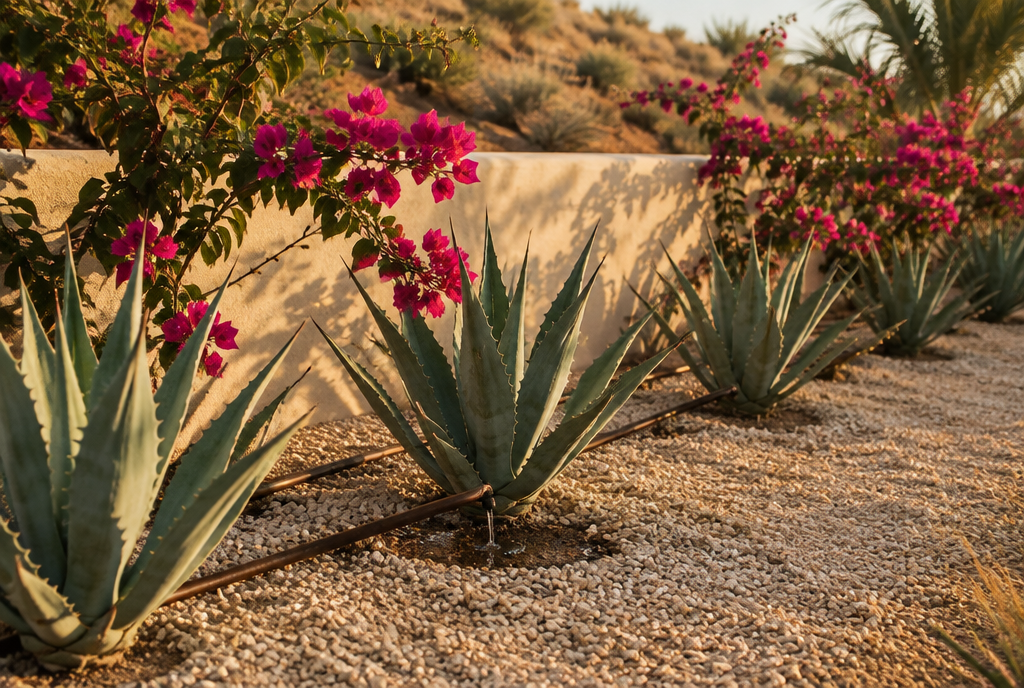
Watch someone water a garden here at eleven in the morning and you will see the same scene every time: a hose, a steady trade wind, and half the spray heading for the neighbor’s wall.
Short answer, up front. For most gardens in the ABC islands, drip irrigation on a tap timer, buried under gravel, is the right default. Sprinklers lose too much to wind and midday heat, and hand watering is worth keeping only for pots and brand-new plants. The rest of this is about why, and where each method still earns its place.
Water here is not free, and the wind takes a share of it
Drinking water across the ABC islands is largely desalinated seawater. It is made with energy and billed accordingly, so every liter that blows off a sprinkler or evaporates from hot soil is one you paid for and the plant never saw.
Wind is the bigger thief than heat. It strips moisture from the top few centimeters of soil faster than sun alone, which is the same point we make in The Lazy Person’s Lush Garden: choose plants for the wind, then water in a way the wind cannot interfere with.
Drip: the default, with two conditions
A drip line puts water at the root, at low pressure, close to the ground. There is no spray to carry sideways, and very little sits on the surface long enough to evaporate. It is the one method the trade wind cannot argue with.
The conditions are simple. Cover it and check it.
Cover it because exposed black tubing gets brittle after a few seasons of island sun, and because a line hidden under gravel looks like a finished garden rather than a construction site. Check it because emitters clog, lines kink and something eventually gets pulled loose. Ten minutes a month, walking the line, catches nearly all of it.
Coral-based soil adds one more wrinkle. It is shallow and drains fast, so water tends to sink rather than spread sideways. Kit instructions are written for loam, so space the emitters closer than the packet suggests. And bring the old connector to the shop: fittings on the islands come from both US and European suppliers, and thread standards do not always match.
The honest trade-off is upfront effort. Drip takes an afternoon to lay out properly and a little attention afterward. In return you stop watering by hand.
Sprinklers: only for the thing that needs them
Sprinklers make sense for one thing, and that is a real lawn. Even then, run them in the calmest hour, usually early morning, before the wind builds.
Point them at planting beds and most of the water is wasted. If your source is brackish well water rather than the mains, overhead spray also leaves salt on the leaves, and leaf burn follows. It is worth asking whether the lawn is the real reason you want sprinklers at all. If it is, our piece on artificial grass covers the alternative, including where it works and where it does not.
Hand watering: keep it for pots and newcomers
Pots in constant wind can dry out in a single afternoon, and no timer schedule rescues a small terracotta pot on an exposed balcony. Water those by hand, and water them slowly.
New plants need the same care. For the first months, soak the root zone deeply with the hose held at the base, rather than sprinkling the surface every day. Deep, infrequent watering pushes roots down. Shallow, frequent watering trains them to stay near the surface, which is exactly where the wind dries them out.
The timer is what pays for the system
A battery tap timer set for early morning turns all of this from a habit into a system. It also stops the most common failure, which is forgetting for a week and then flooding for a day.
Set it to taper as plants establish, and turn it down hard during the short wet season, when rain does real work. On St. Maarten, Saba and St. Eustatius, which are wetter and greener, the risk flips entirely. You are managing runoff and over-watering rather than scarcity, and a rain delay function earns its price quickly.
Water less by knowing your exposure
How much a garden needs depends on where it sits. A front-line garden planted with salt-tolerant species asks for far less than a sheltered courtyard full of thirsty ornamentals. Work out which zone you are in first with How Far From the Sea Are You? and the watering decision gets much smaller.
Our iguana was asked to supervise the hose. He pointed out that the plants were not going anywhere, and neither was he.
FAQ
How often should I water a garden in Aruba, Curaçao or Bonaire?
Established drought-tolerant beds usually need a deep soak about once a week or less. New plantings need water every few days at first, tapering over the first several months. Start there and adjust to what the plants show you.
Does drip irrigation work in constant wind?
Yes. Water is delivered at ground level, so wind cannot carry it away the way it does with sprinklers. Cover the line with gravel or mulch so it survives sun and stays in place.
Is drip worth it for a small courtyard?
Usually, yes. A small kit and a timer cost little, and pots and beds in a tight, hot space are the plants that suffer most when watering is forgotten.
In one line
Put the water at the roots, under gravel, on a timer, and keep the hose for pots and newcomers.
Garden Design Co. — Ideas, spaces and objects that elevate outdoor living.